
Toyota RAV4 (XA40) 2013-2018 Service Manual: Internal control module random access memory (ram) error
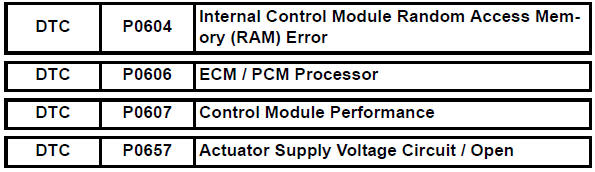
Description
The ecm continuously monitors its own internal memory status, internal circuits, and output signals transmitted to the throttle actuator. This self-check ensures that the ecm is functioning properly. If any malfunction is detected, the ecm sets the appropriate dtc and illuminates the mil.
The ecm memory status is diagnosed by internal mirroring of the main cpu and the sub cpu to detect random access memory (ram) errors. The two cpus also perform continuous mutual monitoring. The ecm illuminates the mil and sets a dtc if: 1) outputs from the two cpus are different or deviate from the standards, 2) the signals sent to the throttle actuator deviate from the standards, 3) a malfunction is found in the throttle actuator supply voltage, and 4) any other ecm malfunction is found.

Monitor strategy
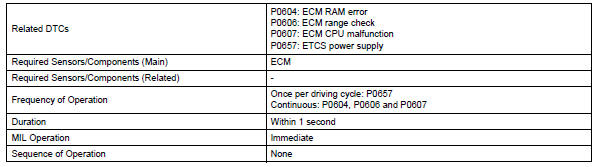
Typical enabling conditions

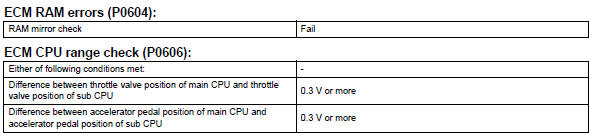
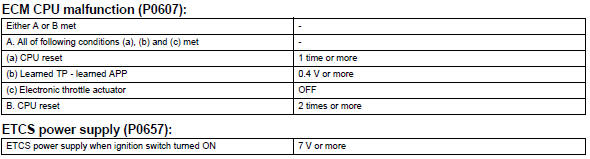
Typical malfunction thresholds
Inspection procedure
Read freeze frame data using the intelligent tester. Freeze frame data records the engine condition when malfunctions are detected. When troubleshooting, freeze frame data can help determine if the vehicle was moving or stationary, if the engine was warmed up or not, if the air-fuel ratio was lean or rich, and other data from the time the malfunction occurred.
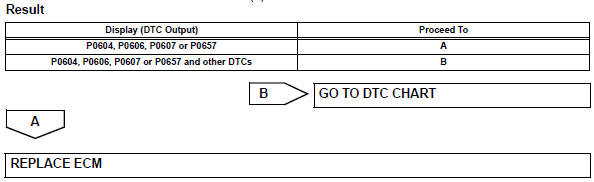
- Check any other dtcs output (in addition to dtc p0604, p0606, p0607 or p0657)
- Connect the intelligent tester to the dlc3.
- Turn the ignition switch on.
- Turn the tester on.
- Select the following menu items: diagnosis / enhanced obd ii / dtc info / current codes.
- Read dtcs.
 System voltage
Description
The battery supplies electricity to the ecm even when the ignition switch is
in the off position. This
power allows the ecm to store data such as dtc history, freeze frame data and ...
 Starter relay circuit high
Description
While the engine is being cranked, the positive battery voltage is applied to
terminal sta of the ecm. If
the ecm detects the starter control (sta) signal while the vehicle is bein ...
Other materials:
Operating instructions
Turning the end of the lever turns on the lights as follows:
Type a
The side marker, parking,
tail, license plate, daytime
running lights and instrument
panel lights turn on.
The headlights and all
lights listed above (except
daytime running lights)
turn on.
The headlights an ...
Detailed bluetooth®
system settings
You can confirm and change the detailed bluetooth® settings.
How to check and change detailed bluetooth® settings
Display the “bluetooth* setup� screen.
Select “system settings�.
The following screen is displayed:
Bluetooth® power on/off. You can change bluetooth®
fu ...
Ts and cg terminal circuit
Description
If the vehicle is stationary during sensor check mode, speed sensor
malfunctions cannot be detected. The
vehicle must be driven for speed sensor malfunctions to be detected.
Hint:
Change to sensor check mode by connecting terminals tc and cg of the dlc3,
and turning the ignitio ...
