
Toyota RAV4 (XA40) 2013-2018 Service Manual: Diaphragm oil seal
Components
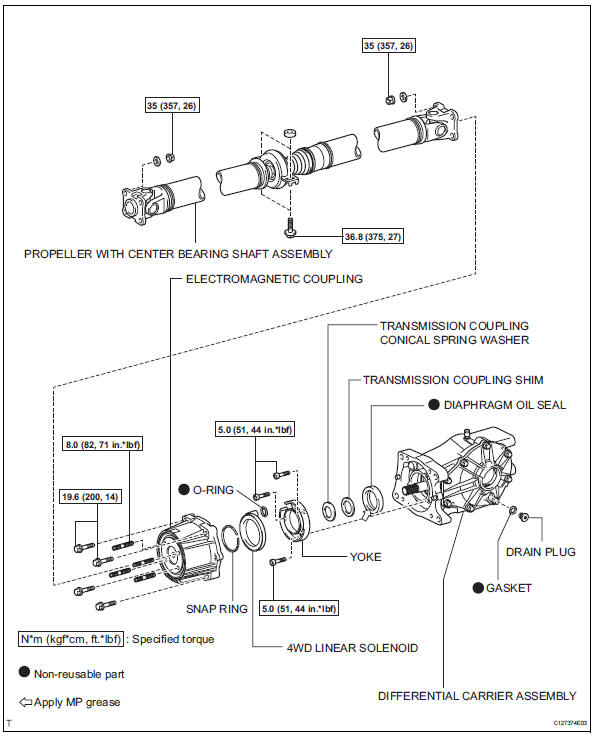
Removal
- Drain differential oil
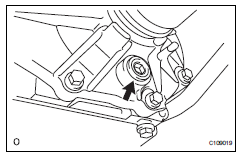
- Using a 10 mm socket hexagon wrench, remove the rear differential drain plug and gasket, and drain the oil.
- Install a new gasket to the rear differential drain plug.
- Using a 10 mm socket hexagon wrench, install the rear differential drain plug and gasket.
- Remove propeller with center bearing shaft assembly (see page pr-3)
- Remove electromagnetic coupling (see page df-21)
- Remove 4wd linear solenoid (see page df-22)
- Remove yoke (see page df-22)
- Remove transmission coupling conical spring washer (see page df-22)
- Remove transmission coupling shim (see page df-22)
- Remove diaphragm oil seal
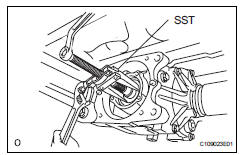
- Using sst, remove the oil seal from the rear differential carrier.
Sst 09308-10010
Installation
- Install diaphragm oil seal
- Apply a light coat of mp grease no. 2 To the lip of a new diaphragm oil seal.
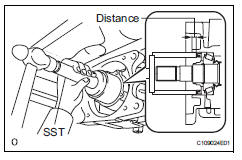
- Using sst and a hammer, tap the diaphragm oil seal into the rear differential carrier according to the specification.
Sst 09710-30021 (09710-03121), 09950-60010 (09951-00570), 09950-70010 (09951-07100)
Standard distance: 7.0 +-0.5 Mm (0.28 +-0.02 In.)
- Install transmission coupling shim (see page df-41)
- Install transmission coupling conical spring washer (see page df-41)
- Install yoke (see page df-41)
- Install 4wd linear solenoid (see page df-41)
- Install electromagnetic coupling (see page df-42)
- Temporarily install propeller with center bearing shaft assembly (see page pr-5)
- Fully tighten propeller with center bearing shaft assembly (see page pr-6)
- Inspect and adjust joint angle (see page pr- 4)
- Add differential oil
- Add differential oil (see page df-3).
- Check for differential oil leakage
If gas is leaking, tighten the areas necessary to stop the leak. Replace damaged parts as necessary.
 Rear differential side gear shaft oil seal
Components
Removal
Drain differential oil (see page df-10)
Remove tailpipe assembly
Remove the tailpipe (see page ex-2).
Remove center exhaust assembly
Remove propelle ...
 Rear differential carrier assembly
Components
...
Other materials:
Smart key system
The following operations
can be performed simply by
carrying the electronic key
on your person, for example
in your pocket. The driver
should always carry the
electronic key.
Locks and unlocks the side
doors
Locks and unlocks the back
door
Starts the engine
â– Antenna location
Antennas ou ...
Short in can bus lines
Description
There may be a short circuit between the can bus lines when the resistance
between terminals 6 (canh)
and 14 (canl) of the dlc3 is below 54
.
Wiring diagram
Inspection procedure
Notice:
Turn the ignition switch off before measuring the resistances of the
main ...
Front passenger side seat belt warning light malfunction
Description
When the ignition switch is on, the center airbag sensor transmits front seat
inner belt status signals to
the combination meter through the can bus line. If the front passenger seat belt
is not fastened, the
heater control panel (automatic a/c) or clock (manual a/c) blinks the fr ...
