
Toyota RAV4 (XA40) 2013-2018 Owners Manual: Fuel information
You must only use unleaded gasoline in your vehicle.
Select octane rating 87 (research octane number 91) or higher.
Use of unleaded gasoline with an octane rating lower than 87 may result in engine knocking. Persistent knocking can lead to engine damage.
At minimum, the gasoline you use should meet the specifications of astm d4814 in the u.S.A..
Fuel tank opening for unleaded gasoline
To help prevent incorrect fueling, your vehicle has a fuel tank opening that only accommodates the special nozzle on unleaded fuel pumps.
Gasoline quality
In very few cases, driveability problems may be caused by the brand of gasoline you are using. If driveability problems persist, try changing the brand of gasoline. If this does not correct the problem, consult your toyota dealer.
Gasoline quality standards
- Automotive manufacturers in the u.S.A., Europe and japan have developed a specification for fuel quality called the world-wide fuel charter (wwfc), which is expected to be applied worldwide.
- The wwfc consists of four categories that are based on required emission levels. In the u.S., Category 4 has been adopted.
- The wwfc improves air quality by lowering emissions in vehicle fleets, and improves customer satisfaction through better performance.
Recommendation of the use of gasoline containing detergent additives
- Toyota recommends the use of gasoline that contains detergent additives to avoid the build-up of engine deposits.
- All gasoline sold in the u.S.A. Contains minimum detergent additives to clean and/or keep clean intake systems, per epa’s lowest additives concentration program.
- Toyota strongly recommends the use of top tier detergent gasoline. For more information on top tier detergent gasoline and a list of marketers, please go to the official website www.Toptiergas.Com.
Recommendation of the use of cleaner burning gasoline
Cleaner burning gasoline, including reformulated gasoline that contains oxygenates such as ethanol or mtbe (methyl tertiary butyl ether) is available in many areas.
Toyota recommends the use of cleaner burning gasoline and appropriately blended reformulated gasoline. These types of gasoline provide excellent vehicle performance, reduce vehicle emissions and improve air quality.
Non-recommendation of the use of blended gasoline
- Use only gasoline containing up to 15%
ethanol.
Do not use any flex-fuel or gasoline that could contain more than 15% ethanol, including from any pump labeled e30, e50, e85 (which are only some examples of fuel containing more than 15% ethanol).
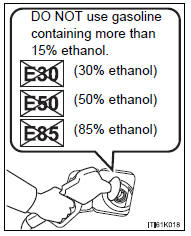
- If you use gasohol in your vehicle, be sure that it has an octane rating no lower than 87.
- Toyota does not recommend the use of gasoline containing methanol.
Non-recommendation of the use of gasoline containing mmt
Some gasoline contains an octane enhancing additive called mmt (methylcyclopentadienyl manganese tricarbonyl).
Toyota does not recommend the use of gasoline that contains mmt. If fuel containing mmt is used, your emission control system may be adversely affected.
The malfunction indicator lamp on the instrument cluster may come on. If this happens, contact your toyota dealer for service.
If your engine knocks
- Consult your toyota dealer.
- You may occasionally notice light knocking for a short time while accelerating or driving uphill. This is normal and there is no need for concern.
Notice
Notice on fuel quality
- Do not use improper fuels. If improper fuels are used, the engine will be damaged.
- Do not use leaded gasoline.
Leaded gasoline can cause damage to your vehicle’s three-way catalytic converters causing the emission control system to malfunction.
- Do not use gasohol other than the type previously stated.
Other gasohol may cause fuel system damage or vehicle performance problems.
- Using unleaded gasoline with an octane number or rating lower than the
level previously stated will cause persistent heavy knocking.
At worst, this will lead to engine damage.
Fuel-related poor driveability
If poor driveability is encountered after using a different type of fuel (poor hot starting, vaporization, engine knocking, etc.), Discontinue the use of that type of fuel.
When refueling with gasohol
Take care not to spill gasohol. It can damage your vehicle’s paint.
 Maintenance data
(fuel, oil level, etc.)
Maintenance data
(fuel, oil level, etc.)
Dimensions and weights
*: Unladen vehicle
Vehicle identification
Vehicle identification number
The vehicle identification number (vin) is the legal identifier for
your vehicle. This is the pr ...
 Tire information
Typical tire symbols
Full-size tire
Compact spare tire
Tire size
Dot and tire identification number (tin)
Location of treadwear indicators
Tire ply composition and materials
Pli ...
Other materials:
Rear window wiper and
washer
The rear window wiper and
washer can be used by
operating the lever.
NOTICE
â– When the rear window is dry
Do not use the wiper, as it may
damage the rear window.
Operating the wiper lever
Operating the switch
operates the rear wiper as follows:
*1 or
*2 Off
*1 or
*2 Intermittent
operation
...
Blower motor circuit
Description
When the heater control (blower switch) is set to position 1 or higher, the
contact of the htr relay is
closed, current flows to the blower motor, and the blower motor operates. The
blower motor speed can be
changed by exchanging the ground and the blower resistor circuit with the ...
Problem symptoms table (2006/01- )
Hint:
Use the table below to help determine the cause of the
problem symptom. The potential causes of the symptoms are
listed in order of probability in the "suspected area" column
of the table. Check each symptom by checking the suspected
areas in the order they are listed. Replace p ...
