
Toyota RAV4 (XA40) 2013-2018 Owners Manual: Tire information
Typical tire symbols
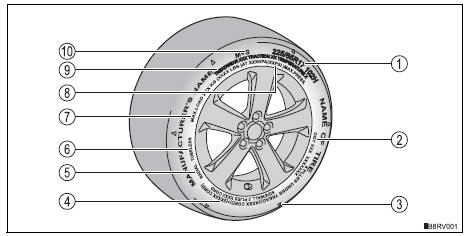
Full-size tire
Compact spare tire
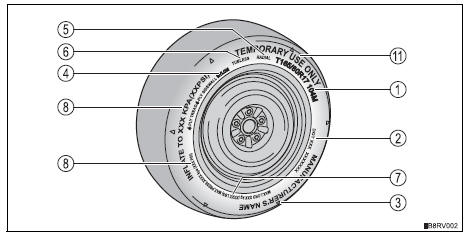
- Tire size
- Dot and tire identification number (tin)
- Location of treadwear indicators
- Tire ply composition and materials
Plies are layers of rubber-coated parallel cords. Cords are the strands which form the plies in a tire.
- Radial tires or bias-ply tires
A radial tire has “radial� on the sidewall. A tire not marked “radial� is a bias-ply tire.
- Tubeless or tube type
A tubeless tire does not have a tube and air is directly put into the tire.
A tube type tire has a tube inside the tire and the tube maintains the air pressure.
- Load limit at maximum cold tire inflation pressure
- Maximum cold tire inflation pressure
This means the pressure to which a tire may be inflated.
- Uniform tire quality grading
For details, see “uniform tire quality grading� that follows.
- Summer tires or all season tires
An all season tire has “m+s� on the sidewall. A tire not marked “m+s� is a summer tire.
- “Temporary use only�
A compact spare tire is identified by the phrase “temporary use only� molded on its sidewall. This tire is designed for temporary emergency use only.
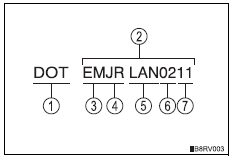
Typical dot and tire identification number (tin)
- Dot symbol*
- Tire identification number (tin)
- Tire manufacturer’s identification mark
- Tire size code
- Manufacturer’s optional tire type code (3 or 4 letters)
- Manufacturing week
- Manufacturing year
*: The dot symbol certifies that the tire conforms to applicable federal motor vehicle safety standards.
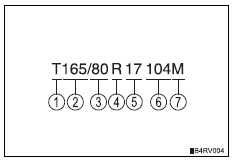
Tire size
Typical tire size information
The illustration indicates typical tire size.
- Tire use
P = passenger car, t = temporary use)
- Section width (millimeters)
- Aspect ratio (tire height to section width)
- Tire construction code (r = radial, d = diagonal)
- Wheel diameter (inches)
- Load index (2 digits or 3 digits)
- Speed symbol (alphabet with one letter)
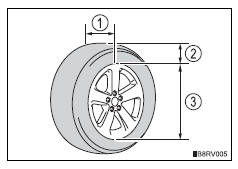
Tire dimensions
- Section width
- Tire height
- Wheel diameter
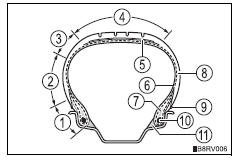
Tire section names
- Bead
- Sidewall
- Shoulder
- Tread
- Belt
- Inner liner
- Reinforcing rubber
- Carcass
- Rim lines
- Bead wires
- Chafer
Uniform tire quality grading
This information has been prepared in accordance with regulations issued by the national highway traffic safety administration of the u.S. Department of transportation.
It provides the purchasers and/or prospective purchasers of toyota vehicles with information on uniform tire quality grading.
Your toyota dealer will help answer any questions you may have as you read this information.
Dot quality grades
All passenger vehicle tires must conform to federal safety requirements in addition to these grades. Quality grades can be found where applicable on the tire sidewall between tread shoulder and maximum section width.
For example: treadwear 200 traction aa temperature a
Treadwear
The treadwear grade is a comparative rating based on the wear rate of the tire when tested under controlled conditions on a specified government test course.
For example, a tire graded 150 would wear one and a half (1 - 1/2) times as well on the government course as a tire graded 100.
The relative performance of tires depends upon the actual conditions of their use. Performance may differ significantly from the norm due to variations in driving habits, service practices and differences in road characteristics and climate.
Traction aa, a, b, c
The traction grades, from highest to lowest, are aa, a, b and c, and they represent the tire’s ability to stop on wet pavement as measured under controlled conditions on specified government test surfaces of asphalt and concrete.
A tire marked c may have poor traction performance.
Warning: the traction grade assigned to this tire is based on braking (straight ahead) traction tests and does not include cornering (turning) traction.
Temperature a, b, c
The temperature grades are a (the highest), b, and c, representing the tire’s resistance to the generation of heat and its ability to dissipate heat when tested under controlled conditions on a specified indoor laboratory test wheel.
Sustained high temperature can cause the material of the tire to degenerate and reduce tire life, and excessive temperature can lead to sudden tire failure.
Grade c corresponds to a level of performance which all passenger car tires must meet under the federal motor vehicle safety standard no. 109.
Grades b and a represent higher levels of performance on the laboratory test wheel than the minimum required by law.
Warning: the temperature grades of a tire assume that it is properly inflated and not overloaded.
Excessive speed, underinflation, or excessive loading, either separately or in combination, can cause heat buildup and possible tire failure.
Glossary of tire terminology
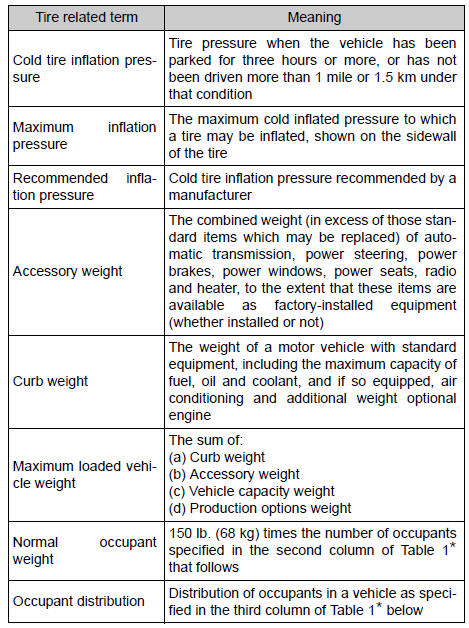
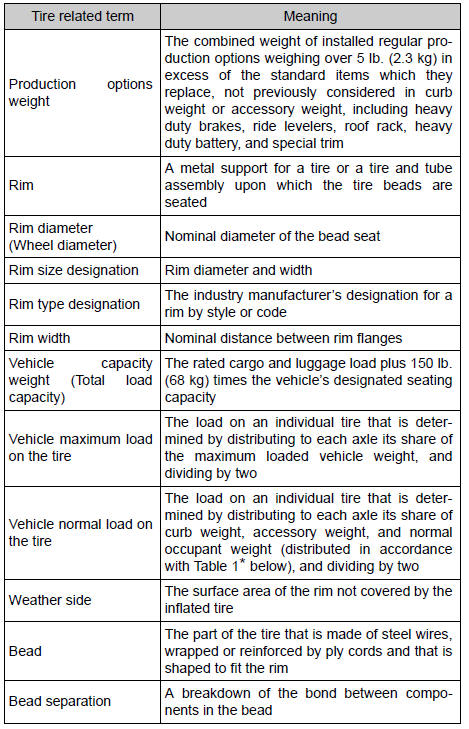
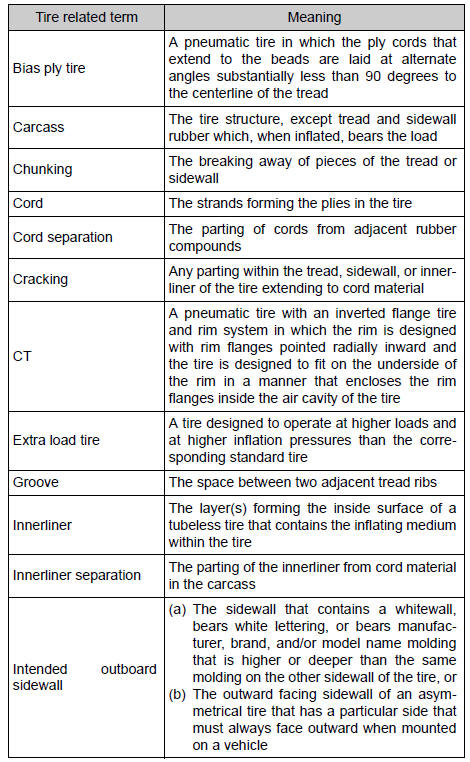
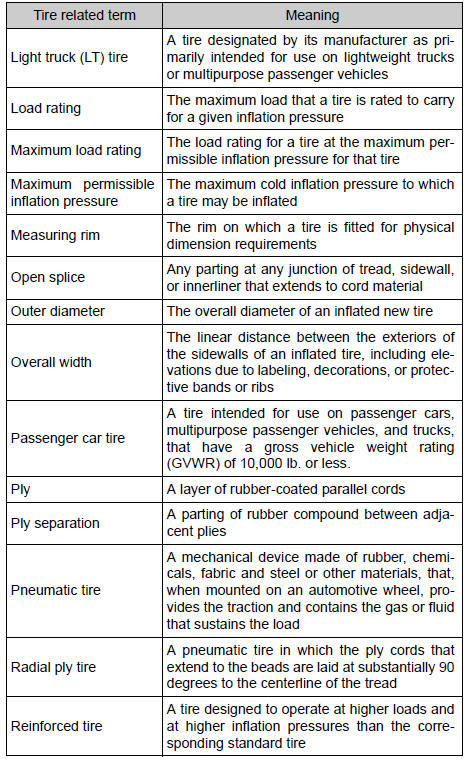
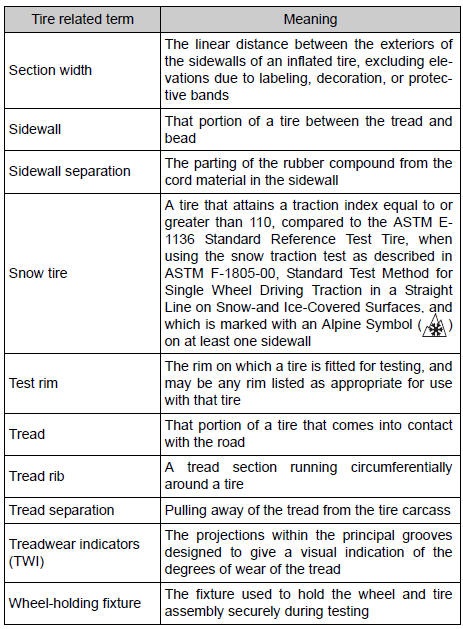
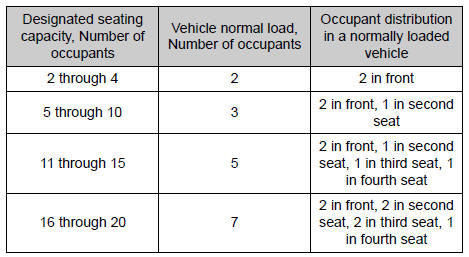
*: Table 1 „o occupant loading and distribution for vehicle normal load for various designated seating capacities
 Fuel information
You must only use unleaded gasoline in your vehicle.
Select octane rating 87 (research octane number 91) or higher.
Use of unleaded gasoline with an octane rating lower than 87
may result in en ...
 Customization
Customizable features
Your vehicle includes a variety of electronic features that can be
personalized to your preferences. The settings of these features
can be changed by using the steering wheel ...
Other materials:
Second brake piston
Components
Disassembly
Remove 2nd brake piston return spring sub-assembly
Place sst on the return spring and compress.
Using a screwdriver, pry out the snap ring.
Remove the piston return spring.
Inspect 2nd brake piston return spring sub-assembly (see page ax-223)
...
Exhaust gas precautions
Harmful substance to the human body is included in exhaust
gases if inhale.
Caution
Exhaust gases include harmful carbon monoxide (co), which is colorless and
odorless. Observe the following precautions.
Failure to do so may cause exhaust gases enter the vehicle and may lead to
an accident c ...
Reassembly
Hint:
Use high-temperature grease to lubricate the bearings,
gears, return spring and steel ball when assembling the
starter.
Install planetary gear
Apply grease to the planetary gears and pin parts of
the planetary shaft.
Install the 3 planetary gears.
Install starter arm ...
