
Toyota RAV4 (XA40) 2013-2018 Service Manual: Automatic transaxle fluid
On-vehicle inspection
- Check transaxle fluid level
Hint:
Drive the vehicle so that the engine and transaxle are at normal operating temperature.
Fluid temperature: 70 to 80°c (158 to 176°f)
- Park the vehicle on a level surface and set the parking brake.
- With the engine idling and the brake pedal depressed, move the shift lever to each position from p to l position, and return it to the p position.
- Take out the atf dipstick and wipe it clean.
- Fully push the dipstick back into the pipe.
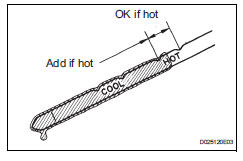
- Take it out and check that the fluid level is at the
hot position.
If there are leaks, it is necessary to repair or replace o-rings, fipgs, oil seals, plugs and/or other parts.
 Torque converter clutch solenoid circuit
Description
The shift solenoid valve dsl is turned on and off by signals from the ecm to
control the hydraulic
pressure acting on the lock-up relay valve, which then controls operation of the ...
 Speed sensor
Components
Removal
Disconnect cable from negative battery
terminal
Caution:
Wait at least 90 seconds after disconnecting the
cable from the negative (-) battery terminal to
prevent ai ...
Other materials:
Refrigerant line
Components (2005/11-2006/01)
Components (2006/01- )
...
Only back door lock / unlock functions do not operate
Description
The main body ecu receives lock / unlock switch signals and activates the
door lock motor accordingly.
Wiring diagram
Inspection procedure
Inspect back door with motor lock assembly
Apply the battery voltage to the door lock motor and
check the operation of the d ...
Underdrive planetary gear
Components
Disassembly
Remove underdrive planetary gear
preload (see page ax-240)
Remove underdrive input shaft nut
Sst 09930-00010 (09931-00010, 09931-00020),
09387-00050, 09564-16020
Using sst, loosen the staked part of the nut.
Clamp the underdrive planetary gear in ...
