
Toyota RAV4 (XA40) 2013-2018 Service Manual: Torque converter clutch solenoid circuit
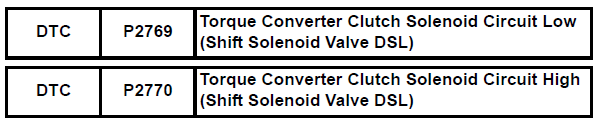
Description
The shift solenoid valve dsl is turned on and off by signals from the ecm to control the hydraulic pressure acting on the lock-up relay valve, which then controls operation of the lock-up clutch.

Fail-safe function: if the ecm detects a malfunction, it turns the shift solenoid valve dsl off.
Monitor description
Torque converter lock-up is controlled by the ecm based on engine rpm, engine load, engine temperature, vehicle speed, transmission temperature, and shift position selection. The ecm determines the lock-up status of the torque converter by comparing the engine rpm (ne) to the input rpm (nt). The ecm calculates the actual transmission gear by comparing the input rpm (nt) to the output rpm (sp2).
When conditions are appropriate, the ecm requests "lock-up" by applying control voltage to the shift solenoid valve dsl. When the shift solenoid valve dsl is opened, the shift solenoid valve dsl applies pressure to the lock-up relay valve and locks the torque converter clutch. If the ecm detects an open or short in the shift solenoid valve dsl circuit, the ecm interprets this as a fault in the shift solenoid valve dsl or its circuit. The ecm will illuminate the mil and store a dtc.
Monitor strategy

Typical enabling conditions
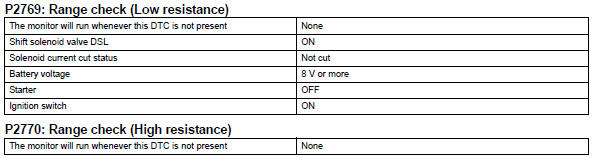

Typical malfunction thresholds

Component operating range

Wiring diagram
Refer to dtc p0741 (see page ax-62).
Inspection procedure
- Inspect transmission wire (shift solenoid valve dsl)
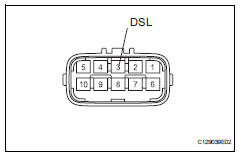
- Disconnect the b27 wire connector.
- Measure the resistance of the transmission wire.
Standard resistance 


- Check wire harness (transmission wire - ecm)
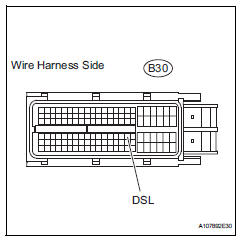
- Disconnect the b30 ecm connector.
- Measure the resistance of the wire harness side connector.
Standard resistance 


Replace ecm
- Inspect shift solenoid valve dsl
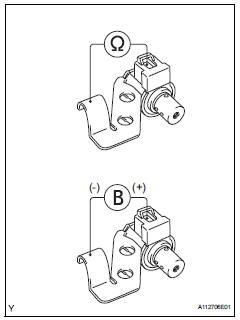
- Remove the shift solenoid valve dsl.
- Measure the resistance between the solenoid valve terminal and solenoid valve body.
Standard resistance:
11 to 13  at 20°c (68°f)
- Connect the battery's positive (+) lead to the terminal of the solenoid valve connector, and the negative (-) lead to the solenoid body. Then check that the valve moves and makes an operating noise.
Ok: valve moves and makes operating noise.


Repair or replace transmission wire
 Pressure control solenoid "d" electrical (shift solenoid valve slt)
Description
Refer to dtc p2714 (see page ax-91).
Monitor description
When an open or short in the shift solenoid valve slt circuit is detected,
the ecm interprets this as a fault.
The ...
 Automatic transaxle fluid
On-vehicle inspection
Check transaxle fluid level
Hint:
Drive the vehicle so that the engine and transaxle are at
normal operating temperature.
Fluid temperature:
70 to 80°c (158 to 176°f ...
Other materials:
Snow mode switch (AWD
vehicles)
Snow mode can be selected
to suit the conditions when
driving on slippery road surfaces,
such as on snow.
System operation
â– Dynamic Torque Control
AWD vehicles
Press the snow mode switch.
When the switch is pressed, the
system switches to snow mode and
the snow mode indicator illuminates
on the ...
Installation
Install camshaft position sensor
Notice:
Make sure that the o-ring is not cracked or jammed
when installing it.
Apply a light coat of engine oil to the o-ring of the
sensor.
Install the sensor with the bolt.
Torque: 9.0 N*m (90 kgf*cm, 80 in.*Lbf)
Connect the sensor co ...
Rear wheel alignment
adjustment
Inspect tire
Inspect the tire (see page tw-1).
Measure vehicle height
Measure the vehicle height (see page sp-3).
Inspect toe-in
Standard toe-in
If the toe-in is not within the specified range, inspect the
suspension parts and replace them if necessar ...
