
Toyota RAV4 (XA40) 2013-2018 Service Manual: Installation
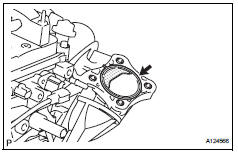
- Install throttle body
- Install a new gasket onto the intake manifold.
- Install the throttle body and fuel pipe clamp with the 4 bolts.
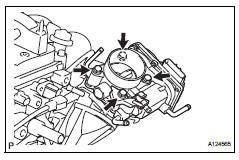
Torque: 30 n*m (305 kgf*cm, 22 ft.*Lbf)
- Connect the fuel tube into the clamp.
- Connect the wire harness clamp.
- Connect the throttle position sensor and control motor connector.
- Connect the no. 1 Throttle body hose to the throttle body
- Connect the no. 2 Water by-pass hose to the throttle body.
- Connect the water by-pass hose to the throttle body.
- Connect the purge line hose to the throttle body.
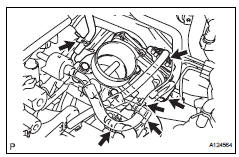
- Install air cleaner cap
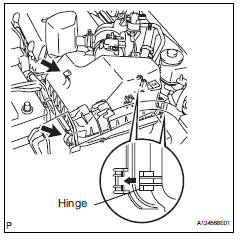
- Install the air cleaner filter element onto the air cleaner case.
- Insert the hinge part of the air cleaner cap into the air cleaner case, then hang the 2 hook clamps.
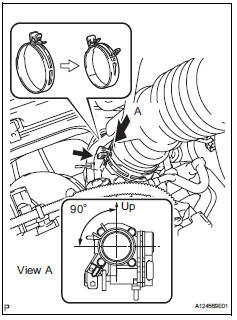
- Align the matchmarks of the no. 1 Air cleaner hose
and throttle body, and then connect the air cleaner
hose no. 1 To the throttle body and unfasten the no.
1 Air cleaner hose clamp.
Notice:
Make sure that the hose clamp is at the correct angle.
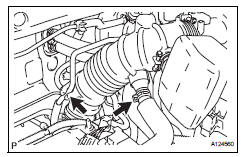
- Connect the purge line hose to the clamp.
- Connect the no. 2 Ventilation hose to the air cleaner hose.
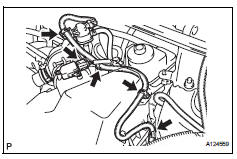
- Install the 4 wire harness clamps.
- Connect the mass air flow meter connector.
- Connect cable to negative battery terminal
- Add engine coolant (see page co-6)
- Check for engine coolant leakage (see page co-1)
- Install no. 1 Engine cover
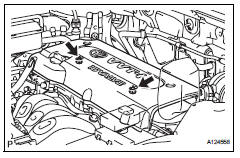
- Install the cover with the 2 nuts.
Torque: 7.0 N*m (71 kgf*cm, 62 in.*Lbf)
 Inspection
Inspect throttle body
Measure the resistance of the throttle control motor.
Standard resistance
If the result is not as specified, replace the throttle
body. ...
 Knock sensor
...
Other materials:
Removal
Disconnect cable from negative battery
terminal
Caution:
Wait at least 90 seconds after disconnecting the
cable from the negative (-) battery terminal to
prevent airbag and seat belt pretensioner activation.
Disconnect cable from positive battery
terminal
Remove battery clamp
...
Pressure control solenoid "B" performance (shift solenoid valve sl2)
Description
The ecm uses signals from the output shaft speed sensor and input speed
sensor to detect the actual
gear position (1st, 2nd, 3rd or o/d gear).
Then the ecm compares the actual gear with the shift schedule in the ecm memory
to detect mechanical
problems of the shift solenoid ...
If your vehicle overheats
The following may indicate that your vehicle is overheating.
The high engine coolant temperature warning light Comes
on or a loss of engine power is experienced. (For example, the
vehicle speed does not increase.)
Steam comes out from under the hood.
Correction procedures
Stop ...
