
Toyota RAV4 (XA40) 2013-2018 Owners Manual: Wheels
If a wheel is bent, cracked or heavily corroded, it should be replaced. Otherwise, the tire may separate from the wheel or cause a loss of handling control.
Wheel selection
When replacing wheels, care should be taken to ensure that they are equivalent to those removed in load capacity, diameter, rim width and inset*.
Replacement wheels are available at your toyota dealer.
*: Conventionally referred to as “offset�.
Toyota does not recommend using the following:
- Wheels of different sizes or types
- Used wheels
- Bent wheels that have been straightened
Aluminum wheel precautions
- Use only toyota wheel nuts and wrenches designed for use with your aluminum wheels.
- When rotating, repairing or changing your tires, check that the wheel nuts are still tight after driving 1000 miles (1600 km).
- Be careful not to damage the aluminum wheels when using tire chains.
- Use only toyota genuine balance weights or equivalent and a plastic or rubber hammer when balancing your wheels.
When replacing wheels (vehicles with the tire pressure warning system)
The wheels of your vehicle are equipped with tire pressure warning valves and transmitters that allow the tire pressure warning system to provide advance warning in the event of a loss in tire inflation pressure.
Whenever wheels are replaced, tire pressure warning valves and transmitters must be installed.
Caution
When replacing wheels
- Do not use wheels that are a different size from those recommended in the owner’s manual, as this may result in a loss of handling control.
- Never use an inner tube in a leaking wheel which is designed for a tubeless tire. Doing so may result in an accident, causing death or serious injury.
When installing the wheel nuts
- Be sure to install the wheel nuts with
the tapered ends facing inward.
Installing the nuts with the tapered ends facing outward can cause the wheel to break and eventually cause the wheel to come off while driving, which could lead to an accident resulting in death or serious injury.
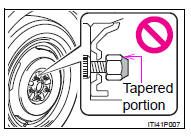
- Never use oil or grease on the wheel bolts or wheel nuts.
Oil and grease may cause the wheel nuts to be excessively tightened, leading to bolt or disc wheel damage. In addition, the oil or grease can cause the wheel nuts to loosen and the wheel may fall off, causing an accident and resulting in death or serious injury. Remove any oil or grease from the wheel bolts or wheel nuts.
Use of defective wheels prohibited
Do not use cracked or deformed wheels.
Doing so could cause the tire to leak air during driving, possibly causing an accident.
Notice
Replacing tire pressure warning valves and transmitters (vehicles with the tire pressure warning system)
- Because tire repair or replacement may affect the tire pressure warning valves and transmitters, make sure to have tires serviced by your toyota dealer or other qualified service shop. In addition, make sure to purchase your tire pressure warning valves and transmitters at your toyota dealer.
- Ensure that only genuine toyota wheels are used on your vehicle.
Tire pressure warning valves and transmitters may not work properly with non-genuine wheels.
 Tire inflation pressure
Tire inflation pressure
The recommended cold tire inflation
pressure and tire size are displayed
on the tire and loading
information label.
Inspection and adjustment procedure
Tire valve
...
 Air conditioning filter
The air conditioning filter must be changed regularly to maintain
air conditioning efficiency.
Removal method
Vehicles without a smart key system: turn the engine switch to the
“lock� posi ...
Other materials:
Input signal circuit abnormal
Description
This dtc expresses the internal abnormalities of the ecm.
Inspection procedure
Check for dtc
Clear the dtc (see page cc-15).
Check for dtc (see page cc-15).
Ok:
dtc is not output.
End ...
Removal
Hint:
Use the same procedures for the rh side and lh side.
The procedures listed below are for the lh side.
Remove rear wheel
Remove rear stabilizer link assembly lh
Remove the nut and disconnect the link from the
suspension no. 2 Arm.
Remove the nut and link from the sta ...
Reassembly
Hint:
Use the same procedures for the rh side and lh side.
The procedures listed below are for the lh side.
Install seat lock release band
Install the band with nut.
Hint:
After installing the band, feed it through the
seatback frame hole towards the rear of the vehicle.
I ...
