
Toyota RAV4 (XA40) 2013-2018 Service Manual: Internal control module random access memory (ram) error
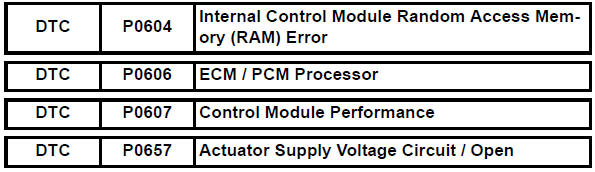
Description
The ecm continuously monitors its own internal memory status, internal circuits, and output signals transmitted to the throttle actuator. This self-check ensures that the ecm is functioning properly. If any malfunction is detected, the ecm sets the appropriate dtc and illuminates the mil.
The ecm memory status is diagnosed by internal mirroring of the main cpu and the sub cpu to detect random access memory (ram) errors. The two cpus also perform continuous mutual monitoring. The ecm illuminates the mil and sets a dtc if: 1) outputs from the two cpus are different or deviate from the standards, 2) the signals sent to the throttle actuator deviate from the standards, 3) a malfunction is found in the throttle actuator supply voltage, and 4) any other ecm malfunction is found.

Monitor strategy
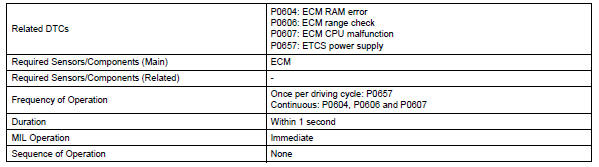
Typical enabling conditions

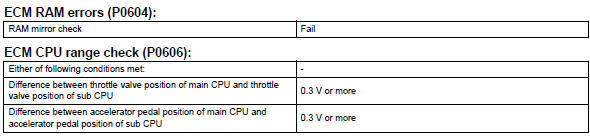
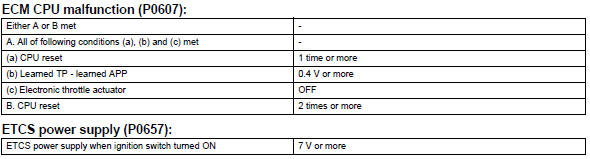
Typical malfunction thresholds
Inspection procedure
Read freeze frame data using the intelligent tester. Freeze frame data records the engine condition when malfunctions are detected. When troubleshooting, freeze frame data can help determine if the vehicle was moving or stationary, if the engine was warmed up or not, if the air-fuel ratio was lean or rich, and other data from the time the malfunction occurred.
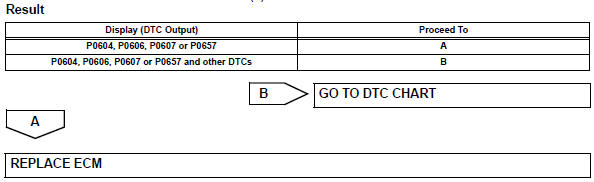
- Check any other dtcs output (in addition to dtc p0604, p0606, p0607 or p0657)
- Connect the intelligent tester to the dlc3.
- Turn the ignition switch on.
- Turn the tester on.
- Select the following menu items: diagnosis / enhanced obd ii / dtc info / current codes.
- Read dtcs.
 System voltage
Description
The battery supplies electricity to the ecm even when the ignition switch is
in the off position. This
power allows the ecm to store data such as dtc history, freeze frame data and ...
 Starter relay circuit high
Description
While the engine is being cranked, the positive battery voltage is applied to
terminal sta of the ecm. If
the ecm detects the starter control (sta) signal while the vehicle is bein ...
Other materials:
System description
Description
The eps (electronic power steering) system generates
torque through the operation of the motor and the
reduction gear installed on the column shaft in order to
assist steering effort.
The power steering ecu determines directions and the
amount of assisting power in accordanc ...
Coolant thermostat (coolant temperature below thermostat regulating
temperature)
Hint:
This dtc relates to the thermostat.
Description
This dtc is set when the engine coolant temperature (ect) does not reach 75°c
(167°f) despite
sufficient engine warm-up time having elapsed.
Monitor description
The ecm estimates the ect based on the starting temperature, en ...
Correct driving posture
Adjust the angle of the seatback
so that you are sitting
straight up and so that you do
not have to lean forward to
steer.
Adjust the seat so that you can
depress the pedals fully and so
that your arms bend slightly at
the elbow when gripping the
steering wheel.
Lock the head ...
