
Toyota RAV4 (XA40) 2013-2018 Owners Manual: List screen operation
When a list screen is displayed, use the appropriate buttons to scroll through the list.
How to scroll
 Select to scroll to the next
or previous page.
 Appears to the right of
titles, the complete titles are
too long for the display. Select
this button to scroll the title.
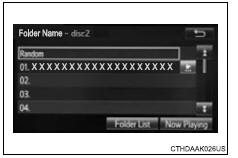
Turn the “tune•scroll� knob to move the cursor box to select a desired item from the list, and press the knob to play it. The track that is being played is highlighted.
To return to the top screen, select “now playing� on the list screen.
Selecting, fast-forwarding and reversing tracks/files/songs
Selecting a track/file/song
Press the “seek >� button or “< track� button, or turn the “tune•scroll� knob to select the desired track/file/song number.
To fast-forward or reverse, press and hold the “seek >� button or “< track� button.
Selecting a track/file/song from the track/file/song list
- Select “browse� or cover art.
- Select the desired track/file/ song.
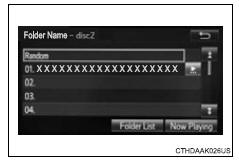
When an mp3/wma/aac disc or usb memory device is being used, the folder can be selected. When a bluetooth® device or ipod is being used, the album can be selected.
According to the audio device, the following is displayed.
| Audio source | List name |
| Audio cd | Track |
| Mp3/wma/aac disc, usb | Folder, album, artist, song, composer, genre, file |
| Bluetooth® | Album, track |
| Ipod | Playlist, artist, album, genre, audiobook, composer, song, video, podcast |
 Selecting the audio
source
Selecting the audio
source
Switching between audio sources such as radio and cd are
explained in this section.
Changing audio source
Press the “audio� button to display the audio source selection
screen.
If the a ...
 Optimal use of the
audio system
Optimal use of the
audio system
On the “sound settings� screen, sound quality (treble/mid/
bass), volume balance can be adjusted.
How to adjust the sound settings and sound quality
Select “-� or “+� to adjust
the tr ...
Other materials:
Short to gnd in can bus line
(2005/11-2006/01)
Description
There may be a short circuit between the can bus line and gnd when there is
resistance between
terminals 6 (canh) and 4 (cg) or terminals 14 (canl) and 4 (cg) of the dlc3.
Wiring diagram
Inspection procedure
Notice:
Turn the ignition switch off b ...
Registration
Perform vehicle stability control system recognition in ecm
Notice:
If the vehicle has both cruise control and vsc, when
replacing ecm, perform vsc recognition as follows:
Turn the ignition switch on.
After waiting approximately 5 seconds, turn the
cruise control main switch on.
Ke ...
Correct driving posture
Adjust the angle of the seatback
so that you are sitting
straight up and so that you do
not have to lean forward to
steer.
Adjust the seat so that you can
depress the pedals fully and so
that your arms bend slightly at
the elbow when gripping the
steering wheel.
Lock the head ...
