
Toyota RAV4 (XA40) 2013-2018 Owners Manual: Maintenance data (fuel, oil level, etc.)
Dimensions and weights
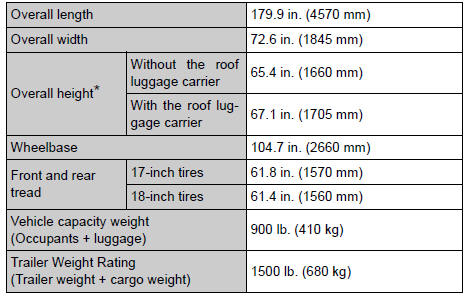
*: Unladen vehicle
Vehicle identification
Vehicle identification number
The vehicle identification number (vin) is the legal identifier for your vehicle. This is the primary identification number for your toyota. It is used in registering the ownership of your vehicle.
This number is stamped on the
top left of the instrument panel. 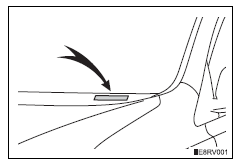
On some models, this number
is stamped under the right-hand
front seat. 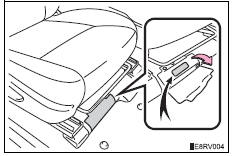
This number is also on the certification
label. 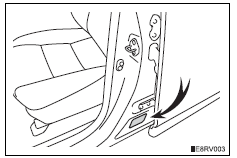
Engine number
The engine number is stamped
on the engine block as shown. 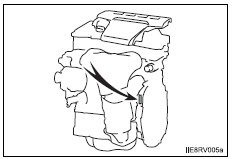
Engine
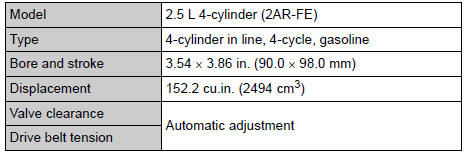
Fuel
Lubrication system

*: The engine oil capacity is a reference quantity to be used when changing the engine oil. Warm up and turn off the engine, wait more than 5 minutes, and check the oil level on the dipstick.
Engine oil selection
“Toyota genuine motor oil� is used in your toyota vehicle. Use toyota approved “toyota genuine motor oil� or equivalent to satisfy the following grade and viscosity.
Oil grade: ilsac gf-5 multigrade engine oil
Recommended viscosity: sae 0w-20
Sae 0w-20 is the best choice for good fuel economy and good starting in cold weather.
If sae 0w-20 is not available, sae 5w-20 oil may be used.
However, it must be replaced
with sae 0w-20 at the next oil
change. 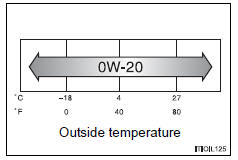
Oil viscosity (0w-20 is explained here as an example):
- The 0w in 0w-20 indicates the characteristic of the oil which allows cold startability. Oils with a lower value before the w allow for easier starting of the engine in cold weather.
- The 20 in 0w-20 indicates the viscosity characteristic of the oil when the oil is at high temperature. An oil with a higher viscosity (one with a higher value) may be better suited if the vehicle is operated at high speeds, or under extreme load conditions.
How to read oil container label:
the international lubricant
specification advisory committee
(ilsac) certification mark
is added to some oil containers
to help you select the oil you
should use. 
Cooling system
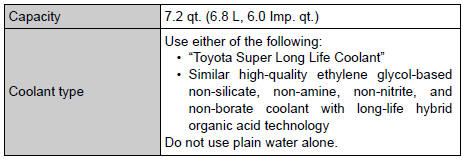
Ignition system

Notice
Iridium-tipped spark plugs
Use only iridium-tipped spark plugs. Do not adjust the spark plug gap.
Electrical system
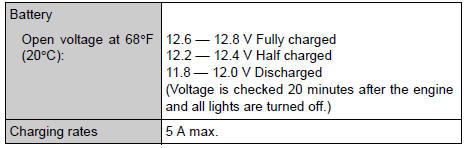
Rear differential (awd models)

Your toyota vehicle is filled with “toyota genuine differential gear oil� at the factory.
Use toyota approved “toyota genuine differential gear oil� or an equivalent of matching quality to satisfy the above specification. Please contact your toyota dealer for further details.
Automatic transaxle

*: The fluid capacity is the quantity of reference.
If replacement is necessary, contact your toyota dealer.
Notice
Automatic transmission fluid type
Using transmission fluid other than “toyota genuine atf ws� may cause deterioration in shift quality, locking up of your transmission accompanied by vibration, and ultimately damage the transmission of your vehicle.
Transfer (awd models)

Your toyota vehicle is filled with “toyota genuine differential gear oil� at the factory.
Use toyota approved “toyota genuine differential gear oil� or an equivalent of matching quality to satisfy the above specification. Please contact your toyota dealer for further details.
Brakes
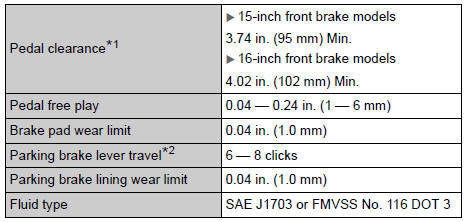
*1: Minimum pedal clearance when depressed with a force of 110 lbf (490 n, 50 kgf) while the engine is operating.
*2: Parking brake lever travel when pulled up with a force of 45 lbf (200 n, 20 kgf)
Steering

Tires and wheels
17-Inch tires
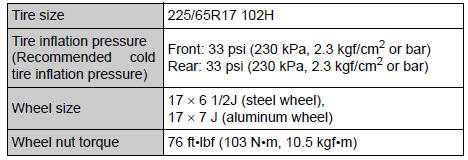
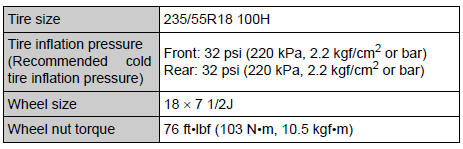
18-Inch tires
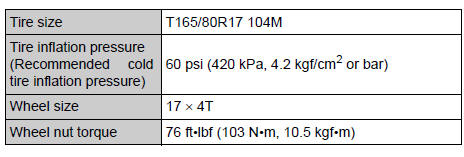
Compact spare tire (if equipped)
Light bulbs
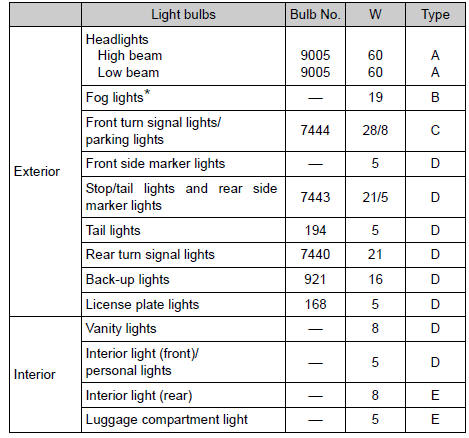
- Hb3 halogen bulbs
- H16 halogen bulbs
- Wedge base bulbs (amber)
- Wedge base bulbs (clear)
- Double end bulbs
*: If equipped
 Specifications
...
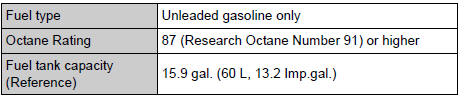
 Fuel information
You must only use unleaded gasoline in your vehicle.
Select octane rating 87 (research octane number 91) or higher.
Use of unleaded gasoline with an octane rating lower than 87
may result in en ...
Other materials:
Installation
Install drive plate sub-assembly
Clean the 8 bolts and 8 bolt holes.
Apply adhesive to 2 or 3 threads of the 8 bolts.
Adhesive:
Toyota genuine adhesive 1342, three bond
1342 or equivalent
Using sst, hold the crankshaft.
Sst 09213-54015 (91651-60855), 09330-00021
Instal ...
Air conditioning control assembly (for automatic air conditioning system)
Components
Removal
Disconnect cable from negative battery
terminal
Notice:
Wait at least 90 seconds after disconnecting the
cable from the negative (-) battery terminal to
prevent airbag and seat belt pretensioner activation.
Remove no. 2 Instrument cluster finish
panel center ...
Assist grips
An assist grip installed on the ceiling
can be used to support your
body while sitting on the seat.
Caution
Assist grip
Do not use the assist grip when getting in or out of the vehicle or
rising from
your seat.
Doing so could damage the assist grip, or could cause you to injure yourse ...
