
Toyota RAV4 (XA40) 2013-2018 Service Manual: Propeller shaft assembly
Components
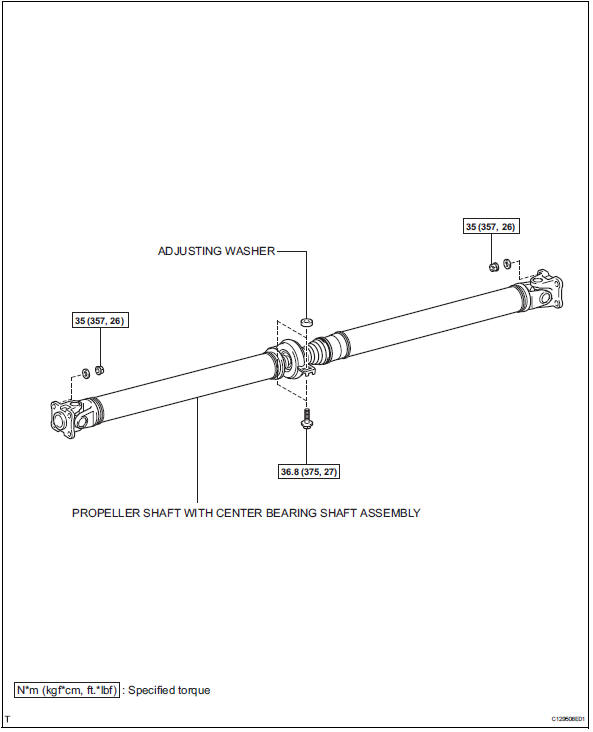
Removal
- Remove propeller shaft with center bearing shaft assembly
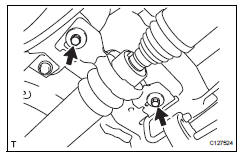
- Remove the 2 bolts and 2 adjusting washers, and disconnect the propeller with center bearing shaft.
Notice:
- During the removal, do not exert excessive force on the universal joint.
- When removing, transporting or storing the propeller with center bearing shaft assembly, do not allow the no. 2 Joint angle to exceed 20Ю
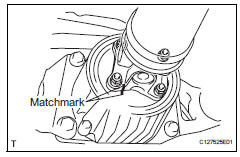
- Place matchmarks on the differential carrier and propeller shaft.
- Remove the 4 nuts and 4 washers, and disconnect the propeller shaft and differential carrier.
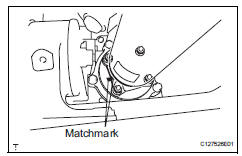
- Place matchmarks on the transfer and propeller shaft.
- Remove the 4 nuts and 4 washers, and disconnect the propeller shaft from the transfer.
Inspection
- Inspect propeller shaft with center bearing shaft assembly
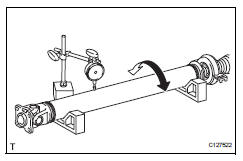
- Using a dial indicator, measure the propeller shaft runout for front side.
Maximum runout: 0.4 Mm (0.02 In.)
If the shaft runout is greater than the maximum, replace the propeller shaft.
Notice:
Place the dial indicator on the center of the shaft, and perpendicular to the shaft.
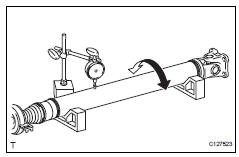
- Using a dial indicator, measure the propeller shaft runout for rear side.
Maximum runout: 0.4 Mm (0.02 In.)
If the shaft runout is greater than the maximum, replace the propeller shaft.
Notice:
Place the dial indicator on the center of the shaft, and perpendicular to the shaft.
- Inspect joint angle
- Before the angle measurement, use procedures like the examples below to stabilize each part.
- Rotate the propeller shaft several times by hand.
- Set the jack to the differential, and raise and lower it.
Notice:
Perform the measurement with a 4 post lift or pit so that the vehicle condition is as close to a standard ground condition as possible.
- Using sst, measure the installation angle of the propeller shaft for front side (a in illustration).
Sst 09370-50010 standard angle a:
-2д9'
-3а1' For w/ 3rd seat
- Using sst, measure the installation angle of the propeller shaft for front side (a in illustration) and propeller shaft for rear side (b in illustration).
Sst 09370-50010
Standard angle a-b: 1г5'
- Using sst, measure the installation angle of the propeller shaft for rear side (b in illustration) and differential carrier rear side (c in illustration).
Sst 09370-50010
Standard angle b-c: 2а4'
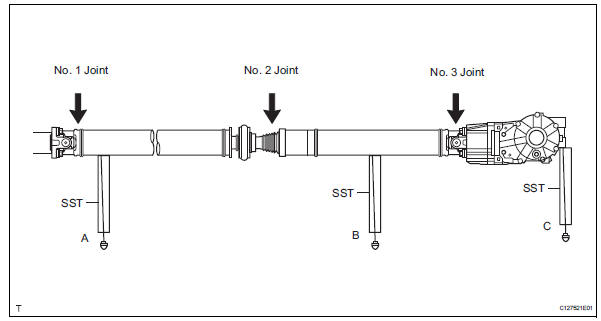
- If the result is not as specified, replace the center support bearing adjusting washer with a more appropriate one.
Notice:
- Use washers of the same thickness on the left and right sides.
- Do not use 2 or more washers stacked together
Standard adjusting washer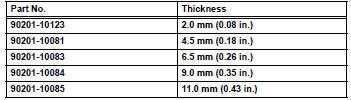
Installation
- Temporarily install propeller shaft with center bearing shaft assembly
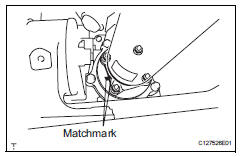
- Align the matchmarks of the transfer and propeller shaft.
- Temporarily install the propeller shaft with center bearing with the 4 nuts and 4 washers.
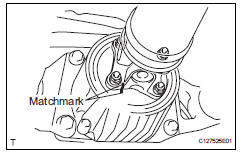
- Align the matchmarks of the differential carrier and propeller shaft.
- Temporarily install the propeller shaft with center bearing with the 4 bolts and 4 washers.
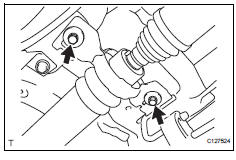
- Temporarily install the center support bearing and center support bearing washer with the 2 bolts.
- Tighten propeller shaft with center bearing shaft assembly
- Tighten the 4 nuts of the propeller shaft and transfer
to the torque specification.
Torque: 35 n*m (357 kgf*cm, 26 ft.*Lbf)
- Tighten the 4 nuts of the propeller shaft and
differential carrier to the torque specification.
Torque: 35 n*m (357 kgf*cm, 26 ft.*Lbf)
- Check that the center line of the center support bearing housing is perpendicular to the axis of the propeller shaft.
- Tighten the 2 bolts of the center support bearing to
the torque specification.
Torque: 36.8 N*m (375 kgf*cm, 27 ft.*Lbf)
- Inspect joint angle (see page pr-4)
 Propeller shaft system
Problem symptoms table
Hint:
Use the table below to help determine the cause of the
problem symptom. The potential causes of the symptoms are
listed in order of probability in the "suspected ...
 Seat
Seat
...
Other materials:
Dtc check / clear
Check dtc
Dtcs which are stored in the ecm can be displayed
with the intelligent tester.
The intelligent tester can display pending dtcs and
current dtcs. Some dtcs are not stored unless a
malfunction is detected in consecutive driving
cycles. When a malfunction is detected ...
Removal
Notice:
Do not heat the vehicle body, emblem and name plate
excessively.
Hint:
When removing the emblem and name plate, heat the vehicle
body, emblem and name plate using a heat light.
Standard heating temperature
Remove no. 1 Back door emblem assembly
Put protective tape aroun ...
Installing child restraints
Follow the child restraint system manufacturer’s instructions.
Firmly secure child restraints to the seats using the latch
anchors or a seat belt. Attach the top tether strap when installing
a child restraint.
The lap/shoulder belt can be used if your child restraint system
is not compati ...
