
Toyota RAV4 (XA40) 2013-2018 Service Manual: Cooling system
On-vehicle inspection
- Check cooling system for lea
ks
- Remove the radiator reservoir cap.
Caution:
To avoid the danger of being burned, do not remove the radiator reservoir cap while the engine and radiator are still hot. Thermal expansion will cause hot engine coolant and steam to blow out from the radiator reservoir.
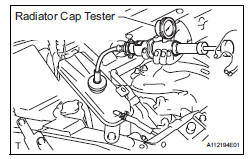
- Fill the radiator and reservoir with coolant, and then attach a radiator cap tester.
- Warm up the engine.
- Pump the radiator cap tester to 118 kpa (1.2 Kgf/
cm2, 17.1 Psi), and then check that the pressure
does not drop.
If the pressure drops, check the hoses, radiator and water pump for leakage.
If there are no signs of external coolant leaks, check the heater core, cylinder block and head.
- Reinstall the radiator reservoir cap.
- Check engine coolant level of reservoir
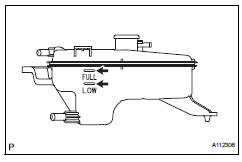
- The engine coolant should be between the low
and full lines when the engine is cold.
If low, check for leakage and add toyota super long life coolant (sllc) or similar high quality ethylene glycol based non-silicate, non-amine, nonnitrite, and non-borate coolant with long-life hybrid organic acid technology up to the full line
- Check engine coolant quality
- Remove the radiator reservoir cap.
Caution:
To avoid the danger of being burned, do not remove the radiator reservoir cap while the engine and radiator are still hot. Thermal expansion will cause hot engine coolant and steam to blow out from the radiator.
- Check for any excessive deposits of rust or scale
around the radiator reservoir cap and radiator filler
hole; the coolant should be free of oil.
If excessively dirty, replace the coolant.
- Install the radiator reservoir cap.
 Battery current sensor
On-vehicle inspection
Check battery current sensor assembly
Measure the resistance of the sensor.
Standard resistance
If the result is not as specified, replace the sensor
assembly.
...
 Cooling fan system
Parts location
System diagram
On-vehicle inspection
Hint:
It is normal for the cooling fan to sometimes rotate when the
ignition switch is turned from acc to on.
Check cooling fan ope ...
Other materials:
Registration
Hint:
The key has 2 codes: the key code (immobiliser code) and
the wireless code (recognition code). Both of these codes
need to be registered. For wireless code registration
procedures, refer to the following procedures (see page dl-
46). For key code registration procedures, refer to the
pro ...
Installation
Install starter assembly
Install the starter with the 2 bolts.
Torque: 37 n*m (377 kgf*cm, 27 ft.*Lbf)
Connect the starter connector.
Install the terminal nut and cover the nut with the
cap.
Torque: 9.8 N*m (100 kgf*cm, 7 ft.*Lbf)
Install battery bracket reinfor ...
Removal
Hint:
Use the same procedures for the rh side and lh side.
The procedures listed below are for the lh side.
Disconnect cable from negative battery
terminal
Caution:
Wait at least 90 seconds after disconnecting the
cable from the negative (-) battery terminal to
prevent airbag and ...
