
Toyota RAV4 (XA50) 2019-2026 Owners Manual: If your vehicle overheats
The following may indicate that your vehicle is overheating.
- The engine coolant temperature gauge shows the red zone or a loss of engine power is experienced. (For example, the vehicle speed does not increase.)
- "Engine Coolant Temp High Stop in a Safe Place See Owner's Manual" is shown on the multi-information display.
- Steam comes out from under the hood.
Correction procedures
1. Stop the vehicle in a safe place and turn off the air conditioning system, and then stop the engine.
2. If you see steam: Carefully lift the hood after the steam subsides.
If you do not see steam: Carefully lift the hood.
3. After the engine has cooled down sufficiently, inspect the hoses and radiator core (radiator) for any leaks.
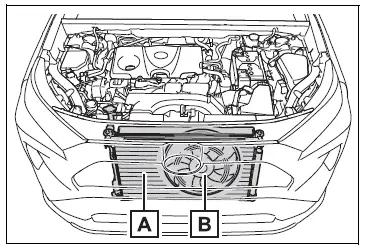
- Radiator
- Cooling fan
If a large amount of coolant leaks, immediately contact your Toyota dealer.
4. The coolant level is satisfactory if it is between the "FULL" and "LOW" lines on the reservoir.
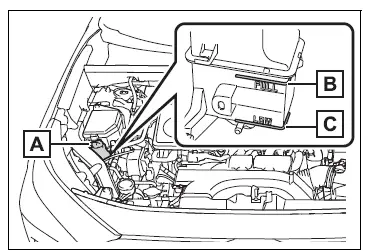
- Reservoir
- "FULL" line
- "LOW" line
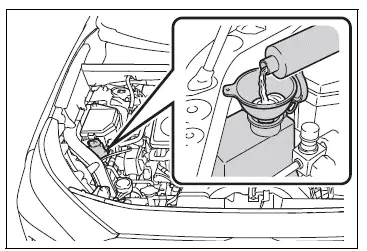
5. Add coolant if necessary.
Water can be used in an emergency if coolant is unavailable.
If water was added in an emergency, have the vehicle inspected at your Toyota dealer as soon as possible.
6. Start the engine and turn the air conditioning system on to check that the radiator cooling fan operates and to check for coolant leaks from the radiator or hoses.
The fan operates when the air conditioning system is turned on immediately after a cold start. Confirm that the fan is operating by checking the fan sound and air flow. If it is difficult to check these, turn the air conditioning system on and off repeatedly. (The fan may not operate in freezing temperatures.)
7. If the fan is not operating: Stop the engine immediately and contact your Toyota dealer.
If the fan is operating: Have the vehicle inspected at the nearest Toyota dealer.
8. Check if "Engine Coolant Temp High Stop in a Safe Place See Owner's Manual" is shown on the multi-information display.
If the message does not disappear: Stop the engine and contact your Toyota dealer.
If the message is not displayed: Have the vehicle inspected at the nearest Toyota dealer.
WARNING
â– When inspecting under the hood of your vehicle
Observe the following precautions.
Failure to do so may result in serious injury such as burns.
- If steam is seen coming from
under the hood, do not open the
hood until the steam has subsided.
The engine compartment may be very hot.
- Keep hands and clothing (especially
a tie, a scarf or a muffler)
away from the fan and belts.
Failure to do so may cause the hands or clothing to be caught, resulting in serious injury.
- Do not loosen the coolant reservoir cap while the engine and radiator are hot. High temperature steam or coolant could spray out.
NOTICE
â– When adding engine coolant
Add coolant slowly after the engine has cooled down sufficiently.
Adding cool coolant to a hot engine too quickly can cause damage to the engine.
â– To prevent damage to the cooling system
Observe the following precautions:
- Avoid contaminating the coolant with foreign matter (such as sand or dust etc.).
- Do not use any coolant additive.
 If the vehicle battery is discharged
The following procedures
may be used to start the
engine if the vehicle's battery
is discharged.
You can also call your
Toyota dealer or a qualified
repair shop.
Restarting the engine
If you have a s ...
 If the vehicle becomes
stuck
If the vehicle becomes
stuck
Carry out the following procedures
if the tires spin or
the vehicle becomes stuck
in mud, dirt or snow:
Recovering procedure
1. Stop the engine. Set the
parking brake and shift the
shift lever to P.
...
Other materials:
Disposal
Hint:
When scrapping a vehicle equipped with an srs or disposing
of the steering pad, be sure to deploy the airbag first in
accordance with the procedure described below. If any
abnormality occurs with the airbag deployment, contact the
service dept. Of toyota motor sales, u.S.A., Inc.
Caution ...
Front passenger side - side airbag sensor circuit malfunction
Description
The side airbag sensor rh consists of parts including the diagnostic circuit
and the lateral deceleration
sensor.
When the center airbag sensor receives signals from the lateral deceleration
sensor, it determines
whether or not the srs should be activated.
Dtc b1625/22 i ...
For vehicles equipped with vehicle stability (vsc) system
Notices when using drum tester
Before beginning testing, disable the vsc. To
disable the vsc, turn the ignition switch off
and connect sst to terminals 12 (ts) and 4
(cg) of the dlc3.
Sst 09843-18040
Notice:
Confirm that the vsc warning light blinks.
Vsc system will be r ...
