
Toyota RAV4 (XA40) 2013-2018 Owners Manual: Installing child restraints
Follow the child restraint system manufacturer’s instructions.
Firmly secure child restraints to the seats using the latch anchors or a seat belt. Attach the top tether strap when installing a child restraint.
The lap/shoulder belt can be used if your child restraint system is not compatible with the latch (lower anchors and tethers for children) system.
Child restraint latch anchors
Latch anchors are provided for
the outside rear seats. (Buttons
displaying the location of the
anchors are attached to the seats.) 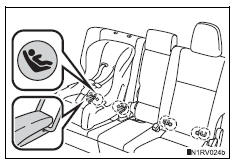
Seat belts equipped with a child
restraint locking mechanism
(alr/elr belts except driver’s
seat belt) 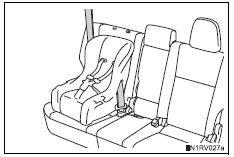
Anchor brackets (for top tether
strap) 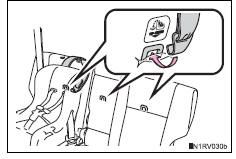
An anchor bracket is provided for each rear seat. (Labels displaying the location of the anchor bracket.)
- Installation with latch system
- Installing child restraints using a seat belt (child restraint lock function belt)
- Child restraint systems with a top tether strap
 Types of child restraints
Child restraint systems are classified into the following 3 types
according to the age and size of the child:
Rear facing „o infant seat/convertible
seat
Forward facing „o convertible
...
 Installation with latch system
Adjust the seatback to the 8th
lock position from the fully
reclined position.
Fully reclined position
8Th lock position
If your child restraint system interferes with a head res ...
Other materials:
Shift lock system
Parts location
System diagram
On-vehicle inspection
Check shift lock operation
Move the shift lever to p.
Turn the ignition switch off.
Check that the shift lever cannot be moved to any
position other than p.
Turn the ignition switch on, depress the brake
pedal and chec ...
Using an anchor bracket
(for top tether strap)
â– Anchor brackets (for top
tether strap)
Anchor brackets are provided
for each rear seat.
Use anchor brackets when fixing
the top tether strap.
Outboard rear seats
Anchor brackets
Top tether strap
Center rear seat
Anchor bracket
Top tether strap
â– Fixing the top tether strap
to the an ...
Removal
Disconnect cable from negative battery
terminal
Caution:
Wait at least 90 seconds after disconnecting the
cable from the negative (-) battery terminal to
prevent airbag and seat belt pretensioner activation.
Remove front seat track bracket outer
cover lh (see page se-11)
Remove fr ...
