Toyota RAV4 (XA50) 2019-2026 Owners Manual: Outside rear view mirrors
The rear view mirror's position can be adjusted to enable sufficient confirmation of the rear view.
â– When using the outside rear view mirrors in a cold weather
When it is cold and the outside rear view mirrors are frozen, it may not be possible to fold/extend them or adjust the mirror surface. Remove the ice, snow, etc. covering the outside rear view mirrors.
â– Defogging the mirrors (if equipped)
The outside rear view mirrors can be cleared using the mirror defoggers.
Turn on the rear window defogger to turn on the outside rear view mirror defoggers.
WARNING
â– Important points while driving
Observe the following precautions while driving.
Failing to do so may result in loss of control of the vehicle and cause an accident, resulting in death or serious injury.
- Do not adjust the mirrors while driving.
- Do not drive with the mirrors folded.
- Both the driver and passenger side mirrors must be extended and properly adjusted before driving.
â– When the mirror defoggers are operating (if equipped)
Do not touch the rear view mirror surfaces, as they can become very hot and burn you.
Adjustment procedure
1. To select a mirror to adjust, press the switch.
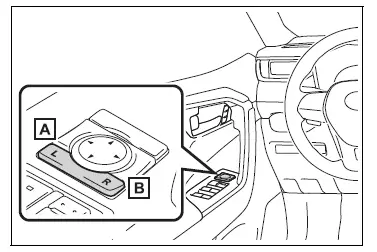
- Left
- Right
2. To adjust the mirror, press the switch.
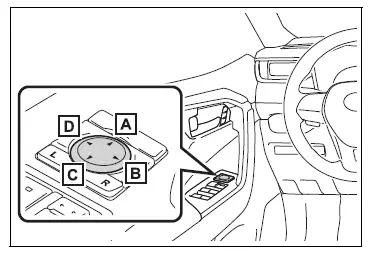
- Up
- Right
- Down
- Left
â– Mirror angle can be adjusted when
The engine switch is in ACC or ON.
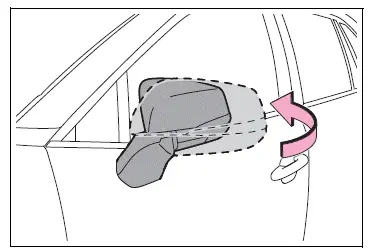
Folding the mirrors
Push the mirror back in the direction of the vehicle's rear.
WARNING
â– When a mirror is moving
To avoid personal injury and mirror malfunction, be careful not to get your hand caught by the moving mirror.
 Cleaning the Digital Rearview
Mirror
â– Cleaning the mirror surface
If the mirror surface is dirty, the
image on the display may be difficult
to see.
Clean the mirror surface gently
using a soft dry cloth.
â– Cleaning the camera
If th ...

Other materials:
Fuel pressure pulsation damper
Components
Removal
Discharge fuel system pressure (see page
fu-9)
Disconnect cable from negative battery
terminal
Remove no. 1 Engine cover (see page es-410)
Remove air cleaner cap sub-assembly (see
page es-411)
Disconnect fuel main tube (see page fu-10)
Remove fuel pres ...
Disassembly (2006/01- )
Remove front axle inboard joint boot no. 2
Clamp
One touch type:
using a screwdriver, remove the no. 2 Inboard joint
boot clamp, as shown in the illustration.
Claw engagement type:
using needle-nose pliers, remove the no. 2 Inboard
joint boot clamp, as shown in the illustra ...
Purpose of readiness tests
The on-board diagnostic (obd ii) system is designed to
monitor the performance of emission related components,
and indicate any detected abnormalities with dtc
(diagnostic trouble codes). Since various components
need to be monitored during different driving conditions,
the obd ii syste ...
