
Toyota RAV4 (XA50) 2019-2026 Owners Manual: Checking the battery
Check the battery as follows.
â– Battery exterior
Make sure that the battery terminals are not corroded and that there are no loose connections, cracks, or loose clamps.
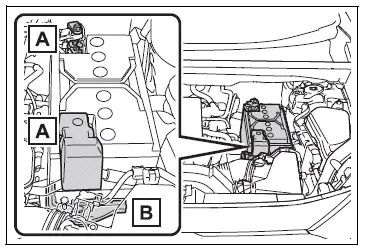
- Terminals
- Hold-down clamp
â– Before recharging
When recharging, the battery produces hydrogen gas which is flammable and explosive. Therefore, observe the following precautions before recharging:
- If recharging with the battery installed on the vehicle, be sure to disconnect the ground cable.
- Make sure the power switch on the charger is off when connecting and disconnecting the charger cables to the battery.
â– After recharging/reconnecting the battery (vehicles with smart key system)
- Unlocking the doors using the smart key system may not be possible immediately after reconnecting the battery. If this happens, use the wireless remote control or the mechanical key to lock/unlock the doors.
- Start the engine with the engine switch in ACC. The engine may not start with the engine switch turned off. However, the engine will operate normally from the second attempt.
- The engine switch mode is recorded by the vehicle. If the battery is disconnected and reconnected, the vehicle will return the engine switch mode to the status it was in before the battery was disconnected. Make sure to turn off the engine switch before disconnecting the battery. Take extra care when connecting the battery if the engine switch mode prior to the battery being disconnected is unknown.
If the engine will not start even after multiple attempts, contact your Toyota dealer.
WARNING
â– Chemicals in the battery
A battery contains poisonous and corrosive sulfuric acid and may produce hydrogen gas which is flammable and explosive. To reduce the risk of death or serious injury, take the following precautions while working on or near the battery:
- Do not cause sparks by touching the battery terminals with tools.
- Do not smoke or light a match near the battery.
- Avoid contact with eyes, skin and clothes.
- Never inhale or swallow electrolyte.
- Wear protective safety glasses when working near the battery.
- Keep children away from the battery.
â– Where to safely charge the battery
Always charge the battery in an open area. Do not charge the battery in a garage or closed room where there is not sufficient ventilation.
â– Emergency measures regarding electrolyte
- If electrolyte gets in your eyes Flush your eyes with clean water for at least 15 minutes and get immediate medical attention. If possible, continue to apply water with a sponge or cloth while traveling to the nearest medical facility.
- If electrolyte gets on your skin
Wash the affected area thoroughly.
If you feel pain or burning, get medical attention immediately.
- If electrolyte gets on your clothes It can soak through clothing on to your skin. Immediately take off the clothing and follow the procedure above if necessary.
- If you accidentally swallow electrolyte Drink a large quantity of water or milk. Get emergency medical attention immediately.
â– When there is insufficient battery fluid
Do not use if there is insufficient fluid in the battery. There is a possible danger that the battery may explode.
NOTICE
â– When recharging the battery
Never recharge the battery while the engine is running. Also, be sure all accessories are turned off.
Adding the washer fluid
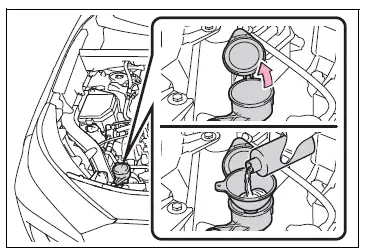
If any washer does not work or the warning message appears on the multi-information display, the washer tank may be empty.
Add washer fluid.
WARNING
â– When adding washer fluid
Do not add washer fluid when the engine is hot or running as washer fluid contains alcohol and may catch fire if spilled on the engine, etc.
NOTICE
â– Do not use any fluid other than washer fluid
Do not use soapy water or engine antifreeze instead of washer fluid.
Doing so may cause streaking on the vehicle's painted surfaces, as well as damaging the pump leading to problems of the washer fluid not spraying.
â– Diluting washer fluid
Dilute washer fluid with water as necessary.
Refer to the freezing temperatures listed on the label of the washer fluid bottle.
 Checking and adding the
brake fluid
Checking and adding the
brake fluid
â– Checking fluid level
The brake fluid level should be
between the "MAX" and "MIN"
lines on the tank.
â– Adding fluid
1. Slide and lift up the rubber
strip to partly remove it as
shown.
2. Discon ...
 Tires
Tires
...
Other materials:
Making a phone call
To enter the “phone� mode, press the off-hook switch.
Making a phone call
Dialing by inputting a name
Speed dialing
Dialing by entering the number
Dialing from call histories
Receiving a phone call
Answering the phone
Refusing the call
Operations during a call
Transfer ...
Theft deterrent system
Engine immobilizer system
The vehicle’s keys have built-in transponder chips that prevent
the engine from starting if a key has not been previously registered
in the vehicle’s on-board computer.
Never leave the keys inside the vehicle when you leave the vehicle.
This system is designed to ...
On-vehicle inspection
Check camshaft timing oil control valve
assembly
Check the operation.
Connect the intelligent tester to the dlc3.
Turn the ignition switch on.
Turn the intelligent tester main switch on.
Start and warm up the engine.
Select the menu items: diagnosis /
enhanced obd ii / ...
