
Toyota RAV4 (XA40) 2013-2018 Service Manual: Monitor drive pattern
- Test monitor drive pattern for ect
Caution:
Perform this drive pattern on a level surface and strictly observe the posted speed limits and traffic laws while driving.
Hint:
Performing this drive pattern is one method to simulate the ect's malfunction detection conditions.
The dtcs may not be detected through ordinary, everyday driving. Also, dtcs may not be detected through this drive pattern.
- Preparation for driving
- Warm up the engine sufficiently (engine coolant temperature is 60°c (140°f) or higher).
- Drive the vehicle when the atmospheric
temperature is -10°c (14°f) or higher.
Malfunction is not detected when the atmospheric temperature is less than -10°c (14°f).
- Drive pattern
- Drive the vehicle through all the gears.
Stop→1st → 2nd →3rd → o/d → o/d (lock-up on).
- Repeat the above drive pattern 3 times or more.
Notice:
- When using the intelligent tester, the monitor status can be found in "enhanced obd ii / data list" or under "carb obd ii".
- In the event that the drive pattern must be interrupted (due to traffic conditions or other factors), the drive pattern can be resumed and, in most cases, the monitor can be completed.
Caution:
Perform this drive pattern on a level road as much as possible and strictly observe the posted speed limits and traffic laws while driving.
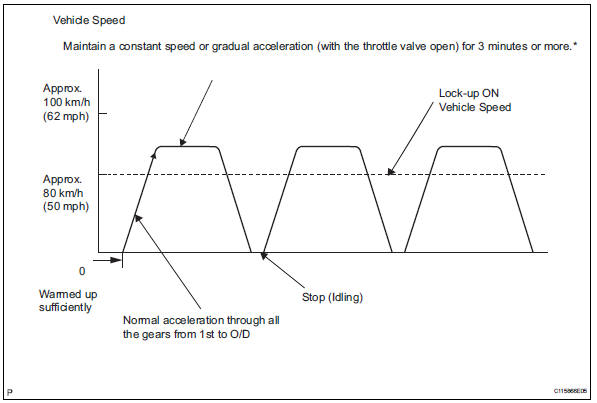
Hint:
*: Drive at such a speed in the uppermost gear to engage lock-up. The vehicle can be driven at a speed lower than the speed shown in the above diagram under the lock-up condition.
Notice:
It is necessary to drive the vehicle for approximately 30 minutes to detect dtc p0711 (transmission fluid temperature sensor "a" performance).
 Manual shifting test
Manual shifting test
Hint:
Through this test, it can be determined whether the
trouble occurs in the electrical circuit or if it is a
mechanical problem in the transaxle.
If any abnorm ...
 Problem symptoms table
Hint:
Use the table below to help determine the cause of the
problem symptom. The potential causes of the symptoms
are listed in order of probability in the "suspected area"
column ...
Other materials:
Coolant thermostat (coolant temperature below thermostat regulating
temperature)
Hint:
This dtc relates to the thermostat.
Description
This dtc is set when the engine coolant temperature (ect) does not reach 75°c
(167°f) despite
sufficient engine warm-up time having elapsed.
Monitor description
The ecm estimates the ect based on the starting temperature, en ...
Assist map number un-writing
Description
The power steering ecu outputs this dtc when it determines that the assist
map is not written in the
ecu.
Hint:
The assist map data is written in the power steering ecu to control assisting
power.
The assist map has 3 types. Select an assist map according to the vehicle
...
On-vehicle inspection
Hint:
When pressing the switch for 0.3 Seconds or less, the roof
glass moves but auto operation does not operate.
Check auto operation
Turn the ignition switch on.
When the roof glass is fully closed, press the slide
open switch for 0.3 Seconds or more. Check that
the roof glass au ...
