
Toyota RAV4 (XA40) 2013-2018 Service Manual: Throttle / pedal position sensor / switch "d" circuit range / performance
Description
Hint:
Refer to dtc p2120 (see page es-282).

Monitor description
When the difference between the output voltages of vpa and vpa2 deviates from the standard, the ecm determines that the accelerator pedal position (app) sensor is malfunctioning. The ecm turns on the mil and the dtc is set.
Monitor strategy
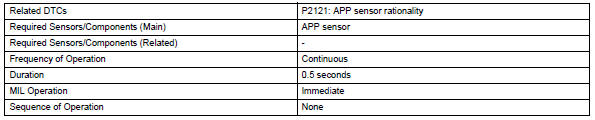
Typical enabling conditions

Typical malfunction thresholds

Fail-safe
The app sensor has two (main and sub) sensor circuits. If a malfunction occurs in either of the sensor circuits, the ecm detects the abnormal signal voltage difference between the two sensor circuits and switches to limp mode. In limp mode, the functioning circuit is used to calculate the accelerator pedal opening angle to allow the vehicle to continue driving. If both circuits malfunction, the ecm regards the opening angle of the accelerator pedal as being fully closed. In this case, the throttle valve remains closed as if the engine is idling.
If a pass condition is detected and then the ignition switch is turned off, the fail-safe operation stops and the system returns to a normal condition.
Wiring diagram
Refer to dtc p2120 (see page es-286).
Inspection procedure
Hint:
Read freeze frame data using the intelligent tester. Freeze frame data records the engine condition when malfunctions are detected. When troubleshooting, freeze frame data can help determine if the vehicle was moving or stationary, if the engine was warmed up or not, if the air-fuel ratio was lean or rich, and other data from the time the malfunction occurred.
- Check any other dtcs output (in addition to dtc p2121)
- Connect the intelligent tester to the dlc3.
- Turn the ignition switch on.
- Turn the tester on.
- Select the following menu items: diagnosis / enhanced obd ii / dtc info / current codes.
- Read dtcs.

Hint:
If any dtcs other than p2121 are output, troubleshoot those dtcs first.


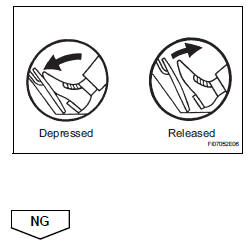
- Read value using intelligent tester (accel pos #1 and accel pos #2)
- Connect the intelligent tester to the dlc3.
- Turn the ignition switch on and turn the tester on.
- Select the following menu items: diagnosis / enhanced obd ii / data list / primary / accel pos #1 and accel pos #2.
- Read the values displayed on the tester.
Standard voltage 

- Replace accelerator pedal assembly

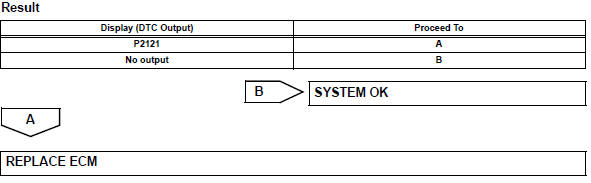
- Check whether dtc output recurs (dtc p2121)
- Connect the intelligent tester to the dlc3.
- Turn the ignition switch o on and turn the tester on.
- Clear dtcs (see page es-35).
- Start the engine.
- Allow the engine to idle for 15 seconds.
- Select the following menu items: diagnosis / enhanced obd ii / dtc info / current codes.
- Read dtcs.
 Throttle / pedal position sensor
Hint:
These dtcs relate to the accelerator pedal position (app) sensor.
Description
Hint:
This etcs (electronic throttle control system) does not use a throttle cable.
The app sensor is mou ...
 Oxygen (a/f) sensor signal stuck
Hint:
Although the dtc titles say oxygen sensor, these dtcs relate to the
air-fuel ratio (a/f) sensor.
Sensor 1 refers to the sensor mounted in front of the three-way
catalytic convert ...
Other materials:
Removal
Caution:
Be sure to read the precautionary notices concerning the
srs airbag system before servicing it (see page rs-1).
Disconnect cable from negative battery
terminal
Caution:
Wait at least 90 seconds after disconnecting the
cable from the negative (-) battery terminal to
prevent air ...
Symptom simulation
Hint:
The most difficult case in troubleshooting is when no
problem symptoms occur. In such a case, a thorough
problem analysis must be carried out. A simulation of the
same or similar conditions and environment in which the
problem occurred in the customer's vehicle should be
carried out. No ...
Hood
Release the lock from the
inside of the vehicle to open
the hood.
Opening the hood
1. Pull the hood lock release
lever.
The hood will pop up slightly.
2. Push the auxiliary catch lever
to the left and lift the hood.
3. Hold the hood open by inserting
the supporting rod into
the slot.
WARNING
â– ...
