
Toyota RAV4 (XA40) 2013-2018 Service Manual: Pressure sensor circuit

Description
This dtc is output when the refrigerant pressure is either extremely low (0.19 Mpa [2.0 Kgf/cm2, 28 psi] or less) or extremely high (3.14 Mpa [32.0 Kgf/cm2, 455 psi] or more). The air conditioning pressure sensor, which is installed on the pipe of the high pressure side, detects the refrigerant pressure and sends refrigerant pressure signals to the air conditioning amplifier. The air conditioning amplifier determines the pressure from the signals in accordance with the sensor characteristics, and controls the compressor accordingly.

Wiring diagram
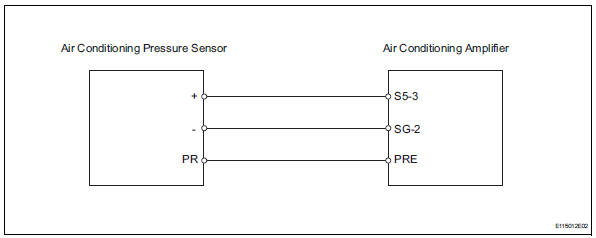
Inspection procedure
- Check refrigerant
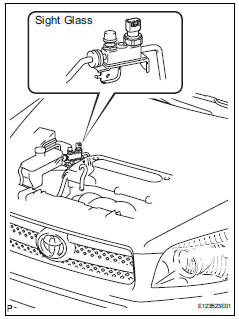
- Check the sight glass of the cooler unit refrigerant liquid pipe.
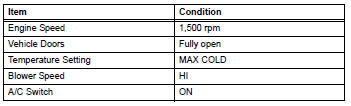
- Prepare the vehicle in accordance with the chart
below.
- Compare the sight glass to the following chart.
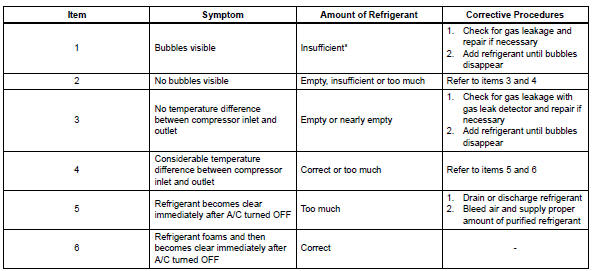
Hint:
*: If the ambient temperature is higher than usual but cooling is sufficient, bubbles in the sight glass are permissible.


- Read value of intelligent tester (reg press sens)
- Connect the intelligent tester (with can vim) to the dlc3.
- Turn the ignition switch on and turn the intelligent tester main switch on.
- Select the item below in the data list, and read the value displayed on the intelligent tester.

Ok: the display is as specified in the normal condition column.


- Check wire harness (pressure sensor - air conditioning amplifier)
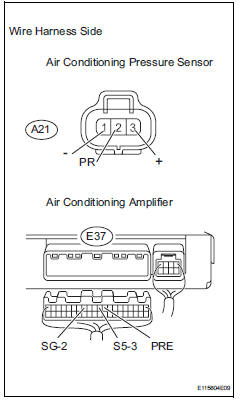
- Disconnect the a21 pressure sensor connector.
- Disconnect the e37 amplifier connector.
- Measure the resistance of the wire harness side connectors.
Standard resistance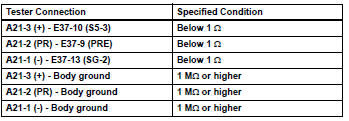


- Check air conditioning amplifier
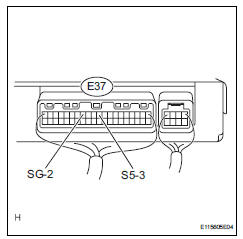
- Remove the air conditioning amplifier with its connectors still connected.
- Measure the resistance of the wire harness side connector.
Standard resistance 
- Turn the ignition switch on.
- Measure the voltage of the wire harness side connector.
Standard voltage 


- Inspect air conditioning pressure sensor
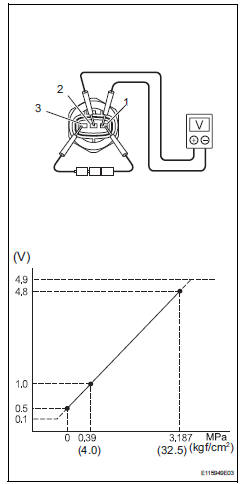
- Turn the a/c switch on.
- Disconnect the a21 sensor connector.
- Connect the three 1.5 V dry cell batteries' positive (+)
lead to terminal 3 and the negative (-) lead to terminal 1.
Then connect the voltmeter's positive (+) lead to terminal 2 and the negative (-) lead to terminal 1. Measure the voltage.
Ok: the voltage changes in accordance with the refrigerant pressure as shown in the graph.


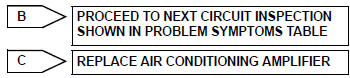
Replace air conditioning amplifier
 Compressor lock sensor circuit
Description
This sensor sends 1 pulse per engine revolution to the air conditioning
amplifier. If the ratio of the
compressor speed divided by the engine speed is smaller than a predetermined ...
 Solar sensor circuit (driver side)
Description
The solar sensor, which is installed on the upper side of the instrument
panel, detects sunlight and
controls the air conditioning auto mode. The output voltage from the solar
se ...
Other materials:
System voltage
Description
The battery supplies electricity to the ecm even when the ignition switch is
in the off position. This
power allows the ecm to store data such as dtc history, freeze frame data and
fuel trim values. If the
battery voltage falls below a minimum level, the memory is cleared and ...
Steering wheel
Adjustment procedure
The steering wheel can be adjusted to a comfortable position.
Hold the steering wheel and
press the lever down.
Adjust to the ideal position by
moving the steering wheel horizontally
and vertically.
After adjustment, pull the lever up
to secure the steering ...
Removal
Hint:
Use the same procedures for the rh side and lh side.
The procedures listed below are for the lh side.
Remove rear wheel
Remove rear stabilizer link assembly lh
Remove the nut and disconnect the link from the
suspension no. 2 Arm.
Remove the nut and link from the sta ...
