
Toyota RAV4 (XA40) 2013-2018 Service Manual: Evaporative emission leak detection pump

Dtc summary
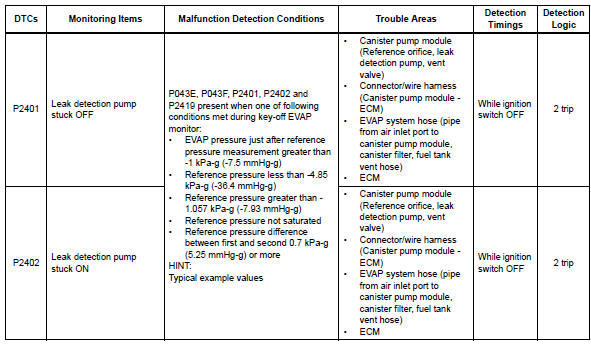
Hint:
The leak detection pump is built into the canister pump module.
Description
The description can be found in the evap (evaporative emission) system (see page es-335).
Inspection procedure
Refer to the evap system (see page es-340).
Monitor description
5 Hours* after the ignition switch is turned off, the leak detection pump creates negative pressure (vacuum) in the evap system. The ecm monitors for leaks and actuator malfunctions based on the evap pressure.
Hint:
*: If the engine coolant temperature is not below 35°c (95°f) 5 hours after the ignition switch is turned off, the monitor check starts 2 hours later. If it is still not below 35°c (95°f) 7 hours after the ignition switch is turned to off, the monitor check starts 2.5 Hours later.

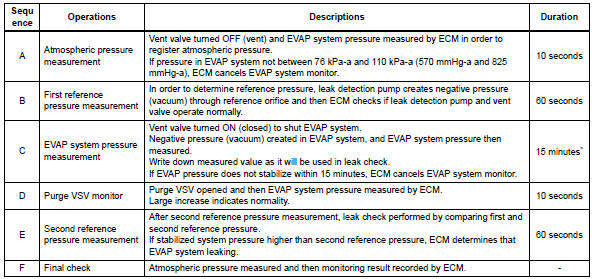
*: If only a small amount of fuel is in the fuel tank, it takes longer for the evap pressure to stabilize.
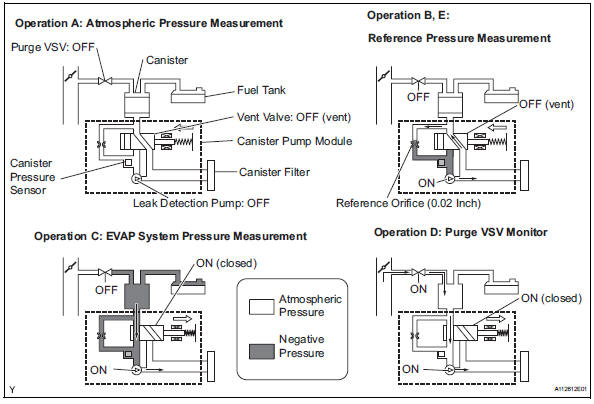
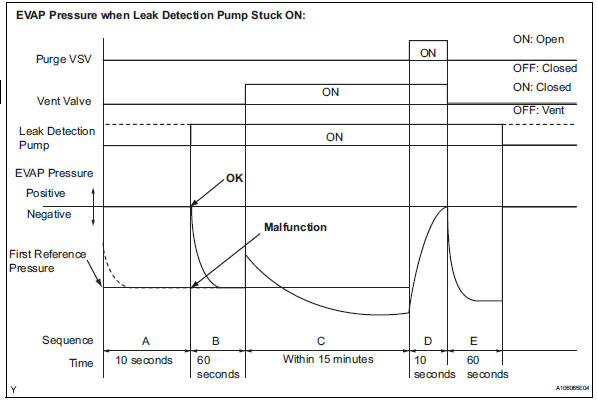
- P2401: leak detection pump stuck off in operation b, the leak detection pump creates negative pressure (a vacuum) through the reference orifice. The evap system pressure is then measured by the ecm, using the canister pressure sensor, to determine the reference pressure. If the pressure is higher than -1.057 Kpa-g (-7.93 Mmhg-g), or lower than -4.85 Kpa-g (-36.4 Mmhg-g), the ecm interprets this as the leak detection pump being stuck off (not operating). The ecm illuminates the mil and sets the dtc (2 trip detection logic).
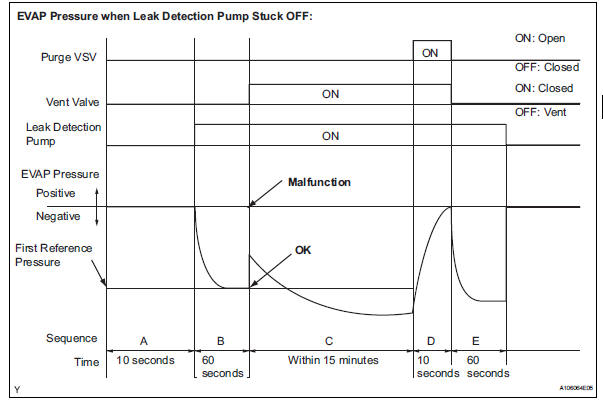
- P2402: leak detection pump stuck on in operation b, the leak detection pump creates negative pressure (a vacuum) through the reference orifice. The evap (evaporative emission) system pressure is then measured by the ecm, using the canister pressure sensor, to determine the reference pressure. If the pressure is higher than -1.057 Kpa-g (-7.93 Mmhg-g), or lower than -4.85 Kpa-g (-36.4 Mmhg-g), the ecm interprets this as the leak detection pump being stuck on (remaining on all the time). The ecm illuminates the mil and sets the dtc (2 trip detection logic).
Hint:
The detection logic of dtcs p2401 and p2402 is the same because in both cases the reference pressure measured in operation b is compared to the atmospheric pressure registered in operation a.
The ecm calculates the difference between these pressures by deducting [the reference pressure] from [the stored atmospheric pressure], and uses this to monitor the evap system pressure change.
Monitor strategy

Typical enabling conditions

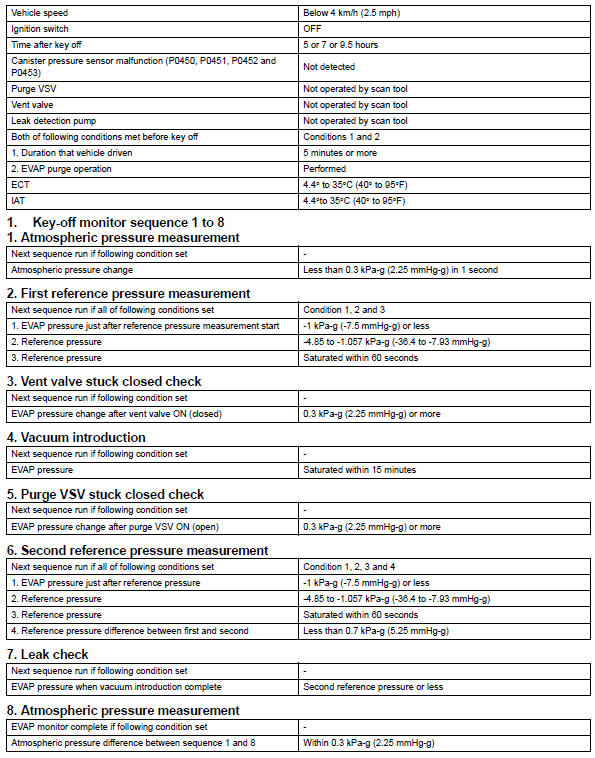
Typical malfunction thresholds
"Saturated" indicates that the evap pressure change is less than 0.286 Kpa-g (2.14 Mmhg-g) in 60 seconds.

Monitor result
Refer to checking monitor status (see page es-17).
 Oxygen (a/f) sensor pumping current circuit
Description
Refer to dtc p2195 (see page es-292).
Monitor description
The air-fuel ratio (a/f) sensor varies its output voltage in proportion to
the air-fuel ratio. If the a/f sensor
imp ...
 Evaporative emission system switching valve control
Dtc summary
Hint:
The vent valve is built into the canister pump module.
Description
The description can be found in the evap (evaporative emission) system (see
page es-335).
Inspection ...
Other materials:
Blower unit
Components
Removal
Disconnect cable from negative battery
terminal
Caution:
Wait at least 90 seconds after disconnecting the
cable from the negative (-) battery terminal to
prevent airbag and seat belt pretensioner activation.
Remove upper instrument panel
Remove the upper ...
Check and replace ecu
Notice:
The connector should not be disconnected from
the ecu. Perform the inspection from the
backside of the connector on the wire harness
side.
When no measuring condition is specified,
perform the inspection with the engine stopped
and the ignition switch on.
Check that the con ...
How to proceed with troubleshooting
Hint:
Perform troubleshooting in accordance with the following
flowchart.
*: Use the intelligent tester.
Vehicle brought to workshop
Inspect battery voltage
Standard voltage:
11 to 14 v
If the voltage is below 11 v, recharge or replace the battery
before proceeding.
Pr ...
